
Chemistry Safety & Sustainable Innovations Festival
Your take-home info sheet
Government High School Basti Azim Shah, Khanpur
- Free entry
- Open to all
- Four hands-on stations
Thank you for joining us. Everything from the four stations is on this page, so you can review it at home, share it with your family, and repeat the safe experiments. Use the buttons above to jump to a section.
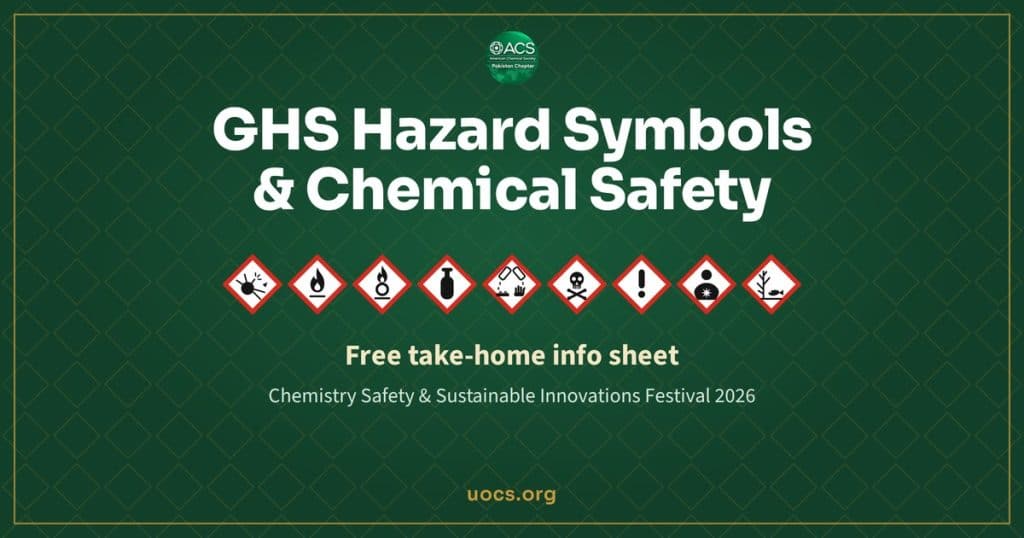
Know the hazard symbols
These red-bordered diamonds are called GHS pictograms. GHS stands for Globally Harmonized System, a shared way of labeling chemicals so people everywhere can read the same warnings. If you can read the diamond, you know what kind of danger to expect.
- ExplosiveCan explode from heat, shock, or friction.Found on: fireworks, ammunition
- FlammableCatches fire easily. Keep away from flames and sparks.Found on: petrol, lighter fuel, nail polish remover, some sprays
- OxidizingMakes fires burn hotter and faster.Found on: some pool chemicals, strong hydrogen peroxide
- Compressed gasGas under pressure. Can burst if heated or dropped.Found on: cooking gas cylinders, aerosol sprays
- CorrosiveBurns skin and eyes, and can eat through metal.Found on: drain cleaner, toilet cleaner, strong bleach
- ToxicCan seriously poison or kill if swallowed, touched, or breathed in.Found on: some pesticides, rat poison
- Harmful or irritantCan irritate skin or eyes, or cause an allergic reaction.Found on: some detergents and disinfectants
- Serious health hazardMay cause long-term harm, such as damage to organs.Found on: petrol, some paint thinners and solvents
- Environmental hazardHarms fish, plants, and water life. Never pour it into a drain or canal.Found on: many pesticides, some paints and thinners
Our drawings are simplified. Always trust the label printed on the real product.
DANGER
The signal word for more serious hazards.
WARNING
The signal word for less serious hazards.
Stay safe with chemicals at home
Most accidents with household chemicals are easy to prevent. These habits cover most of them.
Wearing protective equipment
Goggles protect your eyes from splashes, gloves protect your skin, and an apron protects your clothes and body.
Putting it on
- Apron, tied at the back
- Goggles, snug over your eyes
- Gloves, pulled over the apron cuffs
Taking it off
- Gloves first, peeled off inside out
- Goggles, touching only the strap
- Apron, then wash your hands with soap for 20 seconds
Eight habits worth keeping
- Read the label first. Look for the symbol, the signal word, and the directions before you open anything.
- Never mix cleaners. Bleach mixed with vinegar or with an ammonia cleaner gives off toxic gas. Use one product at a time.
- Keep chemicals in their own container. Never pour them into drink bottles, because someone may drink them by mistake.
- Store them out of reach. Keep cleaners, pesticides, and medicines high up or locked away from small children.
- Let fresh air in. Open a window when you use strong cleaners so the fumes can escape.
- Wash your hands. Use soap after handling chemicals, art supplies, or experiments.
- Do not use expired medicine. Ask a pharmacist how to dispose of it, and never pour it into a drain or a water source.
- Take gas leaks seriously. If a cylinder hisses or you smell gas, use no flames and no switches. Open doors if it is safe, get everyone outside, then call for help from outside.
In an emergency in Punjab, call Rescue 1122.
If someone swallows a chemical, do not make them vomit. Get medical help right away and take the container or label with you.
What you did at the four stations
A short recap of each station, with one thing to try at home.
1
Safe chemical handling and hazard awareness
What you did
Read real product labels, matched hazard symbols to products, and practiced putting on goggles, gloves, and an apron.
Remember this
The symbol tells you what kind of danger a product has. The signal word tells you how serious it is. Protective equipment is your last line of defense, so handle chemicals carefully first.
At home: With an adult, find three hazard symbols on products in your house. Check that each one is stored out of reach of small children.
2
Green chemistry in action
What you did
Watched baking soda and vinegar react, made a bioplastic strip to take home, and compared hazardous products with greener ones.
Remember this
Green chemistry tries to prevent waste and use safer materials from the start, instead of cleaning up afterward. The volcano works like this:
NaHCO3 + CH3COOH → CH3COONa + H2O + CO2
Baking soda and vinegar make a harmless salt, water, and carbon dioxide gas. The soap traps the gas in foam.
Hazardous choices and greener swaps
| Hazardous | Greener choice |
|---|---|
| Chlorine bleach cleaner | Vinegar and baking soda, for light cleaning |
| Single-use plastic bag | Cornstarch-based bioplastic |
| Synthetic pesticide spray | Neem-oil based pesticide |
| Petroleum-based solvent | Citrus-peel based solvent |
| Lead-based paint | Water-based, low-VOC paint |
| Styrofoam packaging | Recycled paper packaging |
A greener choice is not always risk free. Read the label and follow the directions.
At home: Think of one product your family uses that has a greener swap. Talk it over with an adult before changing anything.
3
Water quality testing and environmental monitoring
What you did
Tested the pH and hardness of tap water, canal or well water, distilled water, and a soft drink, then compared the results.
Remember this
pH shows how acidic or basic something is. Hardness comes from dissolved calcium and magnesium, and it is why kettles get chalky scale. Here is where common things sit on the pH scale.
The boxed part is the range drinking water usually falls in, 6.5 to 8.5.
- 2Lemon juice
- 3Soft drink
- 7Pure water
- 8Baking soda in water
- 12Household bleach
Important: a test strip cannot show germs or harmful chemicals such as arsenic. Only proper lab tests can. If you are unsure about your drinking water, ask your local health or water authority about testing.
At home: Ask an adult where your family’s drinking water comes from, and how it is kept clean.
4
Chemistry in everyday products
What you did
Read the labels of soap, juice, and medicine packaging, played with oobleck, and talked through safety situations you might meet at home.
Remember this
A label tells you the ingredients, the hazards, how to store the product, and when it expires. Oobleck is a non-Newtonian fluid, so it acts like a solid when you hit it and like a liquid when you go slowly.
What would you do? Tap a situation for the safest answer
You spill a little cooking oil on the kitchen floor.
Cover it with something absorbent such as paper or a sprinkle of flour, wipe it up, then wash the floor with dish soap and warm water. Keep children away until it is dry, because oil is a slipping hazard.
You mix bleach with an ammonia cleaner and notice a strong smell.
Leave the room right away and get to fresh air, and take others with you. Do not try to clean it up. Tell an adult, and get medical help if anyone coughs, has trouble breathing, or has burning eyes.
You find an old, expired medicine bottle.
Do not take it or share it. Give it to an adult and ask a pharmacist how to dispose of it. Never pour it into a drain or a water source.
A younger sibling wants to taste colorful liquid soap because it looks like juice.
Calmly take it away and say it is soap, not food. Offer real juice or water, and tell an adult. If any was swallowed, get an adult and medical help right away. Do not make them vomit.
A gas cylinder at home is making a hissing sound.
Use no flames and no electrical switches. Open doors and windows if it is quick and safe, get everyone outside, then call the gas supplier or Rescue 1122 from outside.
You want to clean a rusty tool without a harsh rust remover.
Soak it in white vinegar for several hours or overnight, scrub with a brush, rinse, and dry it completely. Rub on a thin coat of oil to slow new rust. Vinegar is a mild acid that dissolves rust.
At home: Pick one product and read its whole label, out loud, to a family member. What is the safest way to store it?
Try it again at home
Ask an adult to help, especially with heating. Work on a tray, and never taste or eat what you make.
Baking soda volcano
You need
- A small plastic bottle and a tray
- 2 tablespoons baking soda
- A few drops of dish soap
- Food coloring
- About ¼ cup vinegar
Steps
- Stand the bottle in the tray.
- Add the baking soda, soap, and color.
- Pour in the vinegar and step back.
What is happening: the acid in vinegar reacts with baking soda to make carbon dioxide gas. The soap traps the gas, so you get foam. Do not cap the bottle, and never use bleach in place of vinegar.
Cornstarch bioplastic
You need
- 1 tablespoon cornstarch
- 4 tablespoons water
- 1 teaspoon vinegar
- 1 teaspoon glycerin, from a pharmacy
- Food coloring, optional
- Aluminium foil
Steps
- Mix everything in a small pot.
- An adult heats it gently, stirring, until it turns thick and see-through, about 3 to 5 minutes.
- Let it cool for a few minutes.
- Spread it thin on foil.
- Dry it flat for 2 to 3 days.
What is happening: heat and water loosen the starch chains, and glycerin keeps them flexible. Starch plastic is weak and softens in water, which is an honest limit of this material.
Oobleck
You need
- 1 cup cornstarch
- ½ cup water, added slowly
- A tray or large bowl
Try this
- Mix by hand until it flows when tilted.
- Punch it quickly. It feels hard.
- Sink a finger in slowly. It flows.
- Roll a ball, then stop rolling.
What is happening: tiny starch particles float in water. A fast push locks them together like a solid, and a slow push lets them slide past each other. Scrape leftovers into the bin, never down the sink, because it can block pipes.
Green chemistry in one minute
Green chemistry means designing products and processes that use and create less hazardous material. Chemists follow 12 principles, first set out by Paul Anastas and John Warner in 1998. Three of them showed up at the festival:
- Prevent waste instead of cleaning it up later.
- Use safer chemicals, such as water and vinegar, wherever possible.
- Use renewable materials, such as the cornstarch in your bioplastic.
Test yourself
Answer in your head first, then tap to check.
Which symbol warns that a product can burn skin, eyes, and metal?
Corrosive. It shows liquid dripping from two test tubes onto a hand and a metal bar.
Which gas fizzes up when baking soda meets vinegar?
Carbon dioxide, CO2.
Why should you never mix bleach with vinegar or an ammonia cleaner?
They release toxic gases. Bleach with an acid such as vinegar makes chlorine gas, and bleach with ammonia makes harmful chloramine fumes.
What is the pH of pure, neutral water?
About 7.
Does a pH strip prove water is safe to drink?
No. It cannot show germs or chemicals such as arsenic. Those need proper lab tests.
What is the main goal of green chemistry?
To design products and processes that prevent waste and avoid hazardous substances from the start.