
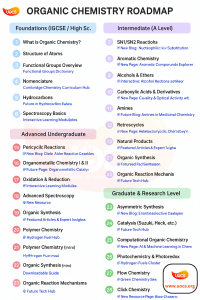
Organic Chemistry Roadmap: From IGCSE to Advanced Research
Explore a complete learning pathway in Organic Chemistry — from Cambridge IGCSE basics to advanced graduate-level research topics. This roadmap is designed for students, teachers, and researchers seeking a structured approach to mastering organic chemistry concepts.
1. Foundations (IGCSE / High School)
(Cambridge IGCSE 0620/0971)
- What is Organic Chemistry? Scope & Importance
- Structure of Atoms and Molecules in Organic Compounds
- Types of Bonds: Ionic, Covalent, Polar, Non-polar
- Hybridization (sp, sp², sp³) & Molecular Geometry
- Functional Groups Overview
- Structural & Geometrical Isomerism
- Nomenclature of Organic Compounds
- Conformations of Alkanes & Cycloalkanes
- Acidity, Basicity, pKa values
- Hydrocarbons: Properties & Simple Reactions
- Spectroscopy Basics (IR intro)
- Reaction Types (Substitution, Addition, Elimination)
2. Intermediate (A Level)
(Cambridge A Level 9701, Papers 2–5)
- Nucleophilic Substitution: SN1, SN2
- Elimination Reactions (E1, E2)
- Electrophilic Additions to Alkenes
- Radical Reactions in Hydrocarbons
- Aromatic Chemistry: Benzene Structure
- Aromatic Substitution Reactions
- Alcohols & Ethers: Reactions & Mechanisms
- Aldehydes & Ketones: Nucleophilic Addition
- Enols & Enolates (Tautomerism, Aldol)
- Carboxylic Acids: Properties & Reactions
- Carboxylic Acid Derivatives
- Regioselectivity & Chemoselectivity
- Stereochemistry: Chirality, Enantiomers, Diastereomers
- Optical Activity & Racemic Mixtures
- Amines: Basicity, Synthesis, Reactions
- Aromatic Heterocycles (Pyridine, Furan)
- Introduction to Polymer Chemistry
- Spectroscopy: Proton NMR & Mass Spectrometry
3. Advanced Undergraduate
(University-level Organic Chemistry I & II)
- Advanced Stereochemistry (stereoselectivity, stereospecificity)
- Pericyclic Reactions (Diels–Alder, Electrocyclic, Sigmatropic)
- Radical Reactions (advanced)
- Rearrangements: Wagner–Meerwein, Beckmann, Hofmann, etc.
- Organometallic Chemistry I: Grignard, Organolithium
- Organometallic Chemistry II: Transition Metal Catalysis
- Conjugation & Delocalization (UV–Vis, resonance stabilization)
- Effects of Structure & Medium on Reactivity (solvent, steric, electronic effects)
- Addition to Carbon–Hetero Bonds (epoxides, imines, nitriles)
- Oxidations: PCC, Swern, MnO₂, green oxidants
- Reductions: LiAlH₄, NaBH₄, hydrogenation
- Advanced Spectroscopy: ¹³C NMR, 2D NMR (COSY, HSQC, HMBC)
- Kinetics & Thermodynamics of Organic Reactions
- Retrosynthesis & Synthetic Planning (Disconnection Approach)
- Natural Products Chemistry (terpenes, alkaloids, polyketides)
- Polymers in Depth: Biodegradable, Conducting Polymers
4. Graduate & Research Level
(PhD / Research Specializations, not in Cambridge syllabus)
- Asymmetric Synthesis (enantioselectivity, organocatalysts)
- Catalysis: Suzuki, Heck, Stille, Negishi, Sonogashira
- C–H Activation & Functionalization
- Computational Organic Chemistry & Mechanistic Modelling
- Photochemistry in Organic Synthesis (Norrish, photoredox)
- Modern Radical Photoredox Catalysis
- Organocatalysis (amine, NHC, thiourea catalysis)
- Green Organic Chemistry (solvent-free, microwave, ionic liquids)
- Flow Chemistry & Continuous Flow Reactors
- Click Chemistry (CuAAC, SPAAC, bioorthogonal reactions)
- Supramolecular Organic Chemistry (host–guest systems)
- Organic Electronics (OLEDs, Solar Cells, OFETs)
- Organic Nanomaterials & Graphene Chemistry
- Biological Organic Chemistry (enzyme mechanisms, coenzymes)
- Medicinal Chemistry & Drug Design (SAR, prodrugs, bioisosteres)
- Organic Chemistry of Natural Products (biosynthetic pathways)
- Emerging Methods: Machine Learning in Reaction Prediction
- Frontier Research: Artificial Enzymes, Molecular Machines
This roadmap is part of the UOCS Learning Hub, designed to guide students, educators, and researchers through the entire spectrum of Organic Chemistry. Each topic will soon be linked to detailed notes, problem sets, and interactive modules.
For further reading and practice, explore a wide range of Organic Chemistry Books for all Levels available at ChemistryDocs.com.
Continue your learning journey and Explore Chemistry with interactive topics, guides, and resources across all branches of chemistry.