

Introduction to Green Chemistry in Action
Did you know that the drugs we take, the clothes we wear, and even the batteries powering our cars are undergoing a quiet chemical revolution?
Green chemistry—once a niche science—is now rewriting the rules of manufacturing, right down to the molecules.
While the world races toward clean energy and climate goals, another transformation is unfolding—invisible to most, but deeply impactful. From pharmaceuticals to plastics, eco-friendly chemistry is not just cleaner—it’s smarter.
In this post, we’ll explore real-world breakthroughs in green chemistry that are turning industries greener without sacrificing performance, profit, or public health.
Green Chemistry in Action: Real-World Case Studies Redefining Sustainability
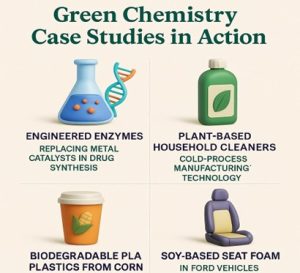
💊 Case Study 1: Prescription Drugs—Redesigned for a Healthier Planet
The Problem:
Pharmaceutical manufacturing often involves complex, multi-step chemical syntheses—sometimes more than 20 reactions per drug. This leads to:
- Enormous solvent consumption
- Hazardous metal catalysts
- High waste-to-product ratios (E-factors as high as 100!)
The Green Breakthrough:
Merck & Codexis revolutionized the synthesis of the anti-diabetic drug sitagliptin by replacing rhodium catalysts with an engineered transaminase enzyme.
The Benefits
- Increased yield by 10–13%
- Replaced hazardous metals with biocatalysts
- Eliminated millions of liters of solvent waste
- Reduced energy-intensive purification steps
Why It Matters: Enzyme catalysis not only improved efficiency but also drastically lowered the environmental footprint—proving that sustainability can drive better performance.
🧼 Case Study 2: Cleaning Products That Clean Without Compromise
The Problem:
Traditional household cleaners rely on synthetic chemicals such as:
- Petroleum-derived surfactants
- VOC-emitting solvents
- Artificial fragrances and preservatives
These ingredients contribute to indoor air pollution, aquatic toxicity, and high carbon emissions.
The Green Breakthrough:
Brands like Ecover, Seventh Generation, and Method have shifted to:
- Plant-based surfactants (from coconut, corn, or sugar)
- Cold-process manufacturing that reduces energy demand
- Recyclable or biodegradable packaging
The Benefits:
- Non-toxic to users and ecosystems
- Reduced carbon footprint during manufacturing
- Enhanced biodegradability in wastewater systems
Why It Matters: Green chemistry brings safety back into the home, replacing harsh chemicals with smart, sustainable alternatives that don’t sacrifice performance.
🧵 Case Study 3: Fabric Dyeing Without Water Waste
The Problem:
Conventional textile dyeing consumes:
- Over 5 trillion liters of water annually
- Massive quantities of toxic fixatives
- High energy for heating and processing
This has made the textile industry one of the top global water polluters.
The Green Breakthrough:
UK biotech company Colorifix has developed a biological dyeing process using genetically modified microbes to:
- Produce pigments using DNA sequences
- Transfer dye directly to fabric without harmful chemicals
The Benefits:
- 90% less water consumption
- No heavy metals or azo dyes
- Fully biodegradable colorants.
Why It Matters: This innovation combines synthetic biology and green chemistry to turn a dirty industry into a cleaner, more responsible one.
♻️ Case Study 4: Compostable Plastics That Close the Loop
The Problem:
Petroleum-based plastics are durable, but they persist for centuries—contributing to microplastic pollution, ocean debris, and landfill overflow.
The Green Breakthrough:
NatureWorks, a leader in bioplastics, manufactures polylactic acid (PLA) from corn starch—a renewable agricultural source.
The Benefits:
- Used in food packaging, utensils, and medical items
- Fully compostable under industrial conditions
- 50% lower carbon emissions compared to PET
Why It Matters: By switching to bio-based and biodegradable polymers, industries can reduce reliance on fossil fuels while minimizing environmental persistence.
🚘 Case Study 5: Soy-Based Seat Foam Driving Automotive Sustainability
The Problem:
Conventional car interiors—seats, dashboards, insulation—are filled with petroleum-based polyurethane foams, adhesives, and coatings that emit VOCs.
The Green Breakthrough:
Ford, in collaboration with Lear Corporation, replaced synthetic foam with soy-derived polyurethane in seat cushions.
The Benefits:
- Over 5 million pounds of petroleum saved annually
- 20 million pounds of CO₂ emissions avoided per year
- Implemented in more than 30 million vehicles globally.
Why It Matters: Ford’s innovation proves that biomaterials can match traditional standards in durability and comfort while cutting emissions at scale.
🔋 Case Study 6: Safe, Sustainable Batteries for Tomorrow’s Grid
The Problem:
Lithium-ion batteries—the backbone of EVs and energy storage—rely on:
- Flammable organic solvents
- Toxic metals like cobalt and nickel
- Complex and unsafe recycling processes
The Green Breakthrough:
New technologies are exploring:
- Aqueous electrolytes for non-flammable, non-toxic chemistry
- Solid-state designs that enhance safety and energy density
- Closed-loop recycling (e.g., by Green Li-ion and Redwood Materials)
The Benefits:
- Enhanced worker safety
- Recyclable battery materials
- Lower lifecycle emissions
Why It Matters: A sustainable energy future depends on green storage solutions—and chemistry is the key to safer batteries that don’t trade sustainability for performance.
What Makes These Applications Truly “Green”?
Let’s break it down:
| Real-World Application Example | Real-World Application Example |
| Less Hazardous Chemical Use | Enzymatic drug synthesis by Merck |
| Renewable Feedstocks | PLA bioplastics from corn by Nature Works |
| Waste Prevention | Textile dyeing by Colori fix |
| Energy Efficiency | Cold-process cleaners from Seventh Generation |
| Safer Products | Soy-based foam in Ford vehicles |
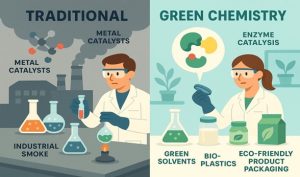
Each of these case studies embodies the 12 Principles of Green Chemistry—not as theory, but as a framework for innovation.
Beyond Innovation: The Business Case for Green Chemistry
This isn’t just about doing what’s right—it’s about doing what works.
🟢 Cost-effective: Less waste = fewer disposal costs
🟢 Compliant: Meets stricter global chemical regulations
🟢 Consumer-driven: Sustainability boosts brand loyalty
🟢 Investor-ready: ESG-aligned businesses attract capital.
Green chemical technologies are a competitive advantage—not an obstacle.
What’s Holding Green Chemistry Back?
While adoption is rising, there are still barriers:
📉 High initial R&D cost
🧪 Lack of awareness or trained chemists
🔗 Inconsistent supply chains for biobased materials
📜 Missing or unclear regulatory frameworks
But here’s the good news: collaboration, education, and policy support are closing these gaps.
Green Chemistry: A Global Shift in Motion
Countries worldwide are waking up to green chemistry’s potential:
- EU Green Deal prioritizes safer chemicals
- EPA’s Safer Choice Program promotes sustainable products
- India’s Green Chemistry Network Centre (GCNC) trains students and researchers
- China’s 14th Five-Year Plan includes green manufacturing strategies
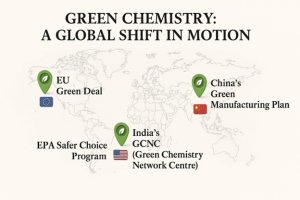
This is more than a trend—it’s a global transition.
Conclusion: Green Chemistry Is Not the Future—It’s the Now
Every molecule designed with intention, every process reimagined for sustainability, is a step toward a cleaner, smarter world. These real-world innovations show us that green chemistry isn’t a distant dream—it’s already transforming the products we use, the industries we rely on, and the planet we share.
From biodegradable plastics to enzyme-powered pharmaceuticals and microbe-dyed fabrics, green chemistry is proving that eco-friendly solutions can also be cost-effective, high-performing, and scalable.
So, here’s the real question: Will your organization be part of this chemical revolution—or get left behind?
Whether you’re a policymaker, a scientist, an entrepreneur, or a curious consumer, now is the time to lean in, learn more, and lead with green chemistry.
🌱 Because in the fight for a sustainable future, the most powerful change starts small—atom by atom.
Read More on Liquid Hydrogen Storage Technologies….
Resources:

