

Introduction to MOFs
Why MOFs Matter in the Clean Energy Era
As the world urgently seeks sustainable energy solutions and carbon mitigation technologies, Metal-Organic Frameworks (MOFs) have emerged as one of the most promising tools in advanced materials science. These highly porous crystalline structures are enabling a new wave of gas storage innovations, especially in the areas of hydrogen storage and carbon dioxide capture.
With their tailor-made architectures, high surface area, and selective adsorption capabilities, MOFs for gas storage are redefining the future of energy and environmental technologies.
Let’s explore how metal-organic frameworks are revolutionizing hydrogen storage and carbon capture.
What Are MOFs and Why Are They Unique?
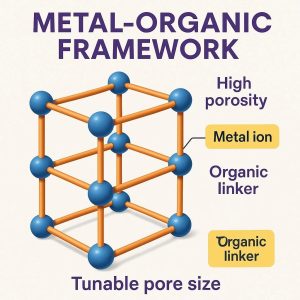
Metal-Organic Frameworks are hybrid materials made by connecting metal ions or clusters with organic linkers to form a three-dimensional structure with exceptional porosity. Some MOFs can have internal surface areas greater than 7,000 m²/g—much higher than traditional adsorbents like zeolites or activated carbon.
Their modular nature means MOFs can be designed atom-by-atom for specific applications, including:
- Hydrogen storage MOFs for clean fuel systems
- CO₂ capture materials for climate tech.
- Gas separation innovations in industrial processes
- MOFs in catalysis for converting captured gases into valuable chemicals.
MOFs for Gas Storage: The Core Advantage
At their core, MOFs are advanced porous materials that offer several unique benefits for gas storage:
- Huge internal surface area to trap large volumes of gas
- Adjustable pore size and chemistry to target specific gas molecules
- Reversible adsorption for easy gas release and reuse
- Lightweight and thermally stable design.
These properties make MOFs ideal for applications that demand both selectivity and capacity, including clean energy systems and industrial gas processing.
Hydrogen Storage MOFs: A Leap Toward Clean Energy
Hydrogen is one of the most promising zero-emission fuels—but storing it safely and efficiently is a challenge. Traditional methods (compressed or liquefied hydrogen) are energy-intensive and have safety risks.
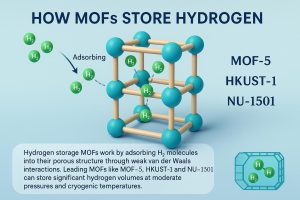
How MOFs Store Hydrogen:
Hydrogen storage MOFs work by adsorbing H₂ molecules into their porous structure through weak van der Waals interactions. Leading MOFs like MOF-5, HKUST-1, and NU-1501 can store significant hydrogen volumes at moderate pressures and cryogenic temperatures.
Key Advantages:
- Higher volumetric and gravimetric hydrogen density
- Lightweight materials for mobile applications (e.g., vehicles)
- Lower energy requirements for storage and release.
Hydrogen storage MOFs are being actively explored for use in fuel cell vehicles, backup power systems, and portable hydrogen tanks.
CO₂ Capture Materials: MOFs in the Fight Against Climate Change
Capturing and storing carbon dioxide is essential for limiting global warming, and MOFs are outperforming traditional sorbents in this space.
How MOFs Capture CO₂:
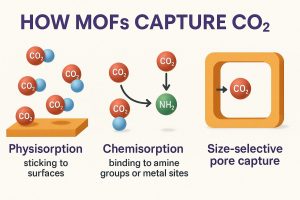
MOFs utilize three main mechanisms:
- Physisorption: CO₂ molecules adhere to the internal surface via van der Waals forces.
- Chemisorption: MOFs functionalized with amine groups or containing open metal sites form strong bonds with CO₂.
- Pore Selectivity: Precise control over pore size allows MOFs to selectively adsorb CO₂ over nitrogen or water vapor.
Advantages:
- High CO₂ selectivity and capacity
- Low regeneration energy
- Effective in post-combustion and direct air capture scenarios
MOFs like UiO-66-NH₂, Mg-MOF-74, and ZIF-8 have demonstrated exceptional performance in capturing CO₂ from industrial emissions and ambient air.
Gas Separation Innovations: Precision at the Molecular Level
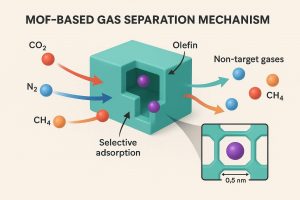
Beyond storage, MOFs are enabling molecular-level gas separations—vital in refining, petrochemicals, and air purification.
Key Gas Separation Applications:
- CO₂/N₂ and CO₂/CH₄ separation in flue gas and natural gas purification
- Olefin/paraffin separation in petrochemical manufacturing
- O₂/N₂ separation for medical and industrial uses
- VOCs removal from indoor air and industrial waste streams.
By tuning pore sizes and surface chemistry, MOFs offer unmatched selectivity and efficiency, outperforming traditional membranes and zeolites.
MOFs in Catalysis: Dual Role in Storage and Conversion
MOFs in catalysis represent another powerful application—especially when combined with their gas storage abilities. Some MOFs act as catalysts themselves, while others serve as highly effective catalyst supports.
Catalytic Applications:
- Electrocatalysis for hydrogen evolution and oxygen reduction
- CO₂ reduction into fuels or chemicals
- Photocatalysis for solar-driven water splitting
- Environmental catalysis for VOC degradation and pollutant removal
These dual-function MOFs offer integrated storage and conversion platforms, advancing the goals of sustainable chemistry and green energy.
Advances in MOF Technology: Toward Industrial-Scale Adoption
While early MOFs were mostly lab-scale, recent breakthroughs are pushing them closer to real-world use.
Innovations Driving MOF Adoption:
- Water-stable and thermally robust MOFs
- Mixed-matrix membranes (MMMs) embedding MOFs into polymers
- 3D printing of MOF monoliths for compact devices
- Post-synthetic modifications (PSM) to fine-tune performance
- Scalable, low-cost synthesis methods.
These developments are turning metal-organic frameworks applications into industrial-ready solutions.
Future Outlook: MOFs as Enablers of Clean Technology
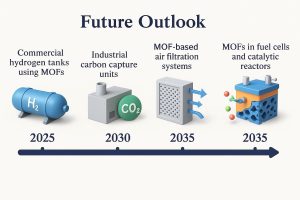
MOFs are no longer just a laboratory novelty—they’re becoming core components of tomorrow’s clean energy and climate infrastructure.
Expected Applications in the Coming Decade:
- Hydrogen-powered transportation
- Modular carbon capture units for factories
- Smart air filtration in urban environments
- Gas-to-liquid catalysis systems
- Portable energy storage for military and disaster response.
As global industries race to decarbonize, MOFs for gas storage and separation will play a central role in the clean-tech revolution.
Conclusion
From storing clean hydrogen to capturing harmful CO₂, Metal-Organic Frameworks are transforming the way we think about gases. With their modular design, exceptional selectivity, and multi-functionality, MOFs offer unmatched potential in building a more sustainable, efficient, and low-carbon future.
Whether it’s hydrogen storage MOFs, CO₂ capture materials, or gas separation innovations, these advanced porous materials are unleashing the next era of energy and environmental technologies.
Read More on Liquid Hydrogen Storage Technologies….
Resources:
Metal-Organic Frameworks (MOFs)

