AI chemical synthesis planning has entered a new era. When AI learned to think like a chemist, everything about molecule design changed. Chemistry has always been a discipline of intuition as much as knowledge. Chemistry has always been a discipline of intuition as much as knowledge. A seasoned chemist does not just know reactions — they feel which pathway is elegant, which route is practical, and which shortcut will collapse under real laboratory conditions. That accumulated instinct, built over decades of training and experimentation, has been the one thing artificial intelligence has consistently failed to replicate.
Until now.
Researchers at EPFL — École Polytechnique Fédérale de Lausanne, Switzerland — have developed Synthegy, a framework that gives large language models genuine chemical reasoning ability. Published in the journal Matter on April 24, 2026, this work represents one of the most significant advances at the intersection of artificial intelligence and chemistry in recent years. This article breaks down exactly how it works, why it matters, and what it means for the future of drug discovery, materials science, and chemical education. Synthegy represents a leap forward in AI chemical synthesis planning — making expert-level reasoning accessible to all.
Understanding the Problem Synthegy Was Built to Solve
What Is Retrosynthesis — and Why Is It So Hard?
To understand Synthegy, you first need to understand retrosynthesis — the core intellectual challenge of synthetic chemistry.
When a chemist wants to make a new molecule — say, a potential cancer drug — they cannot simply assemble it from scratch like building blocks. They must work backward from the target molecule, identifying which simpler, commercially available starting materials could be combined through known reactions to eventually produce it. Each step backward is a decision: which bond to break, which reaction to use, which protecting group to add.
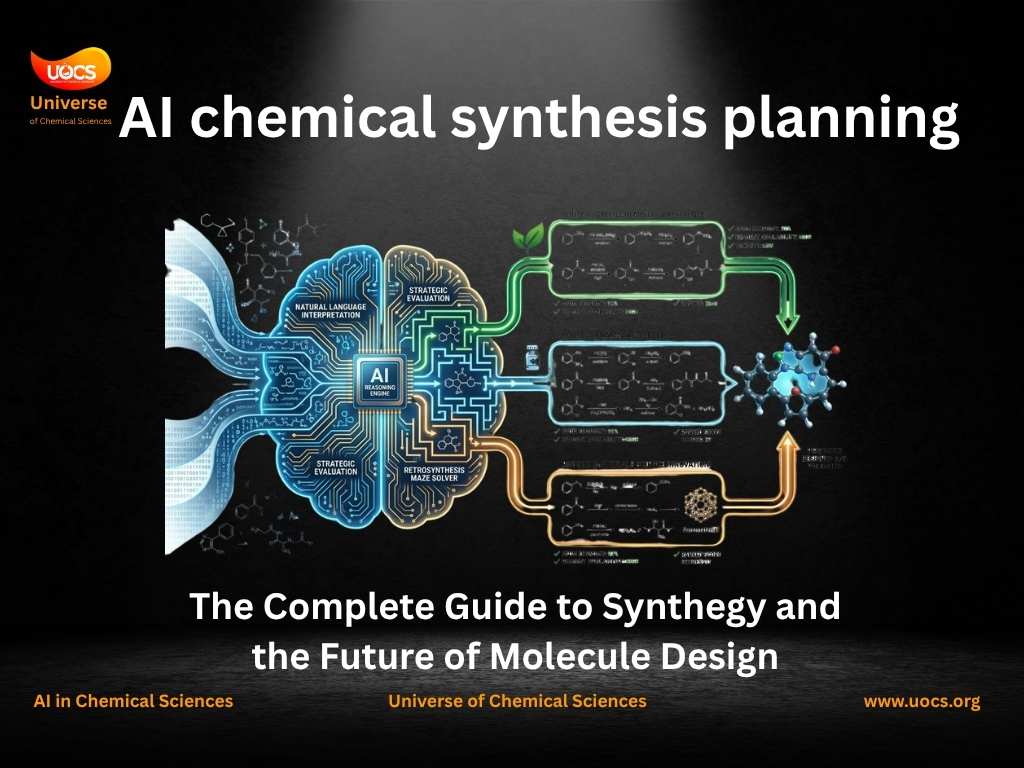
Think of it like solving a maze in reverse. You start at the exit — your target molecule — and work backward to find a clear path to the entrance — your starting materials. Except in chemistry, there are thousands of possible paths, most of which are dead ends, and the maze changes depending on conditions like temperature, solvent, and catalyst.
This is what computational retrosynthesis tools attempt to automate. And for decades, they have fallen short — not because they lacked data, but because they lacked judgment.
The Gap Between Knowing and Reasoning
Existing AI tools for synthesis planning can generate plausible reaction pathways. What they cannot do is evaluate those pathways the way an expert chemist would — by weighing practical considerations, strategic elegance, and chemical intuition simultaneously.
Previous tools relied on rigid rules and filters. If a chemist wanted to bias the search toward green chemistry principles, low-cost starting materials, or a specific reaction class, they had to manually configure complex parameters. There was no way to simply say what you wanted.
Synthegy changes the interface between chemist and computer from a configuration panel to a conversation.
The Science Behind Synthegy — AI Chemical Synthesis Planning
Large Language Models as Chemical Reasoning Engines
At its core, Synthegy integrates large language models (LLMs) — the same class of AI that powers tools like ChatGPT, Claude, and DeepSeek — into the retrosynthesis planning workflow. But rather than using LLMs to generate chemical structures directly (which they do poorly), Synthegy uses them as evaluators and reasoning agents.
Here is the workflow in plain terms:
Step 1 — Natural Language Input
The chemist describes their goal in plain English. For example: “Design a synthesis route for a molecule that inhibits enzyme binding, uses sustainable reagents, and avoids halogenated solvents.” No special syntax, no configuration files — just a sentence.
Step 2 — Search Algorithm Generates Candidates
A traditional retrosynthesis search algorithm generates multiple possible synthesis pathways from the target molecule backward to available starting materials. This is the part existing tools already do reasonably well.
Step 3 — LLM Evaluates and Scores Each Pathway
Here is where Synthegy is genuinely novel. The LLM reads each candidate pathway and evaluates it against the chemist’s stated goals — scoring how well it aligns with the requested strategy, flagging potential practical problems, and explaining its reasoning in natural language.
Step 4 — Ranked Output with Explanations
The system returns the top-ranked pathways with plain-language justifications for each ranking decision. The chemist can then refine their request and iterate.
Elementary Steps and Reaction Mechanisms
Beyond retrosynthesis, Synthegy also tackles reaction mechanism elucidation — breaking complex reactions down into elementary electron-movement steps.
In organic chemistry, every reaction involves the movement of electrons between atoms. These movements follow predictable patterns — nucleophilic attacks, eliminations, rearrangements — but predicting the correct sequence for a novel reaction is enormously complex. Synthegy’s LLM component can explore multiple mechanistic possibilities for a given transformation, ranking them by chemical plausibility based on its training on vast chemical literature.
This is particularly valuable for:
- Predicting byproducts and side reactions
- Understanding why a reaction fails under certain conditions
- Designing better catalysts by understanding the rate-limiting step
The Role of Context — Adding Expert Knowledge as Text
One of Synthegy’s most elegant features is its ability to incorporate additional context as plain text. A chemist can add:
- “Prioritize FDA-approved reagents”
- “This reaction will be run at scale — avoid exothermic steps”
- “The research group has access to a palladium catalyst”
The LLM integrates this context into its evaluation, effectively allowing decades of expert judgment to be communicated in a single sentence. This transforms Synthegy from a search tool into a collaborative reasoning partner.
The Validation — What the Numbers Tell Us
36 Chemists. 368 Evaluations. 71.2% Agreement.
Any AI system claiming to reason like a chemist faces an obvious challenge: how do you prove it? The EPFL team conducted a rigorous double-blind expert evaluation involving 36 independent chemists across multiple institutions. These experts evaluated 368 synthesis planning scenarios, comparing Synthegy’s ranked outputs against their own expert judgments.
The result: 71.2% agreement between Synthegy and expert chemists — on average.
To put this in context, expert chemists typically agree with each other at a similar rate when evaluating complex synthesis strategies. Chemistry is not a discipline with single correct answers — strategic choices reflect individual experience, laboratory resources, and research priorities. An AI system matching expert consensus at the same rate experts agree among themselves is a genuinely remarkable benchmark.
Critically, senior researchers — professors and experienced research scientists — agreed with Synthegy more frequently than PhD students. This suggests the system has internalized the strategic, big-picture reasoning that comes with experience, not just the factual knowledge that can be learned from textbooks.
Model-Agnostic Performance
Synthegy was tested across multiple leading AI models:
- GPT-4o (OpenAI)
- Claude (Anthropic)
- DeepSeek-r1
Performance was consistently strong across all three, demonstrating that the framework’s power lies in its architecture — how it integrates LLMs into the synthesis planning workflow — rather than dependence on any single AI model. This makes Synthegy practically deployable across institutions with different AI infrastructure and budget constraints.
Real-World Applications — Three Industries That Change
1. Pharmaceutical Drug Discovery
Drug discovery is one of the most expensive, time-consuming processes in modern science. On average, bringing a new drug from initial discovery to market takes 10–15 years and costs over $2 billion. A significant portion of that time is spent in the early-stage synthesis planning phase — identifying viable chemical routes to promising drug candidates.
Synthegy directly compresses this timeline. A medicinal chemist can now:
- Rapidly evaluate synthesis routes for multiple drug candidates simultaneously
- Prioritize routes that use FDA-approved reagents, reducing regulatory complexity
- Identify potential synthesis bottlenecks before entering the laboratory
For antibiotic resistance — one of the most urgent global health crises — faster access to novel molecular scaffolds could be genuinely life-saving. AI chemical synthesis planning tools like Synthegy are already reshaping how pharmaceutical companies approach early-stage drug development.
2. Green Chemistry and Sustainable Synthesis
One of Synthegy’s most important applications is in green chemistry — the design of chemical processes that minimize waste, reduce energy consumption, and eliminate hazardous reagents.
Previously, incorporating green chemistry principles into synthesis planning required manually filtering computational outputs against green chemistry metrics. With Synthegy, a chemist can simply instruct: “Prioritize atom-economical reactions and water-compatible conditions.”
The system evaluates pathways against these criteria automatically — democratizing sustainable synthesis planning for research groups that lack dedicated green chemistry expertise. For a world facing climate urgency and chemical pollution crises, this is not a minor convenience. It is a structural shift in how sustainable chemistry gets done.
3. Advanced Materials Science
Beyond pharmaceuticals, Synthegy opens new possibilities in materials science — the design of polymers, semiconductors, nanomaterials, and functional coatings.
Materials chemists face the same retrosynthesis challenge as medicinal chemists, but with additional complexity: the properties of a material emerge not just from its molecular structure but from how molecules arrange themselves at larger scales. Synthegy’s ability to incorporate performance specifications — “design a polymer with high thermal stability and biodegradability” — as natural language input makes it a powerful tool for accelerating materials discovery in areas including:
- Biodegradable packaging polymers
- Organic photovoltaics for solar energy
- Drug delivery nanoparticles
- High-performance battery electrolytes
What Synthegy Cannot Do — and Why That Matters
Scientific honesty requires acknowledging limitations. Synthegy is not a replacement for the chemist — it is an amplifier.
Current limitations include:
- No laboratory execution: Synthegy plans synthesis routes but cannot predict all practical challenges that emerge in actual laboratory conditions — solvent interactions, equipment limitations, operator skill.
- Training data boundaries: Like all LLMs, Synthegy’s reasoning is bounded by the chemical literature it was trained on. Genuinely novel reaction classes with no literature precedent remain beyond its reliable reach.
- Hallucination risk: LLMs can occasionally generate chemically plausible-sounding but incorrect reasoning. Expert review of Synthegy’s outputs remains essential, particularly for high-stakes pharmaceutical applications.
- Quantitative property prediction: Synthegy reasons about synthesis strategies, not molecular properties like binding affinity, toxicity, or solubility — which require separate computational tools.
These limitations are not reasons to dismiss Synthegy. They are reasons to deploy it thoughtfully — as a powerful first-pass reasoning tool that dramatically accelerates expert decision-making rather than replacing it.
The Bigger Picture — A New Era of Conversational Chemistry
Synthegy is not just a better retrosynthesis tool. It represents a paradigm shift in the human-computer interface for chemistry.
For most of computational chemistry’s history, the bottleneck has been translation — translating chemical intuition into the formal language that computers understand. Chemists spent enormous time learning to use computational tools rather than using those tools to do chemistry. Synthegy inverts this. The computer now learns to understand the chemist’s language.
This has profound implications for chemistry education as well. Early-career researchers and undergraduate students can now access expert-level synthesis reasoning without years of accumulated experience — accelerating their development and democratizing access to sophisticated chemical thinking across institutions worldwide, including those in developing countries with limited access to experienced mentors.
Lead author Andres M. Bran of EPFL captured this vision precisely: “When making tools for chemists, the user interface matters a lot, and previous tools relied on cumbersome filters and rules.” Synthegy replaces the filter panel with a conversation — and in doing so, makes computational chemistry genuinely accessible for the first time.
Conclusion: The Chemist and the Machine
The question has never been whether AI will transform chemistry. It has always been how — and when. Synthegy’s publication in Matter in April 2026 marks a clear answer: the transformation is already underway, and it begins with something as simple as a sentence.
The era of conversational chemistry is not coming. It is here. This is the story of AI chemical synthesis planning, how AI learned to think like
a chemist — and why it changes everything.
Key Takeaways
- Synthegy advances AI chemical synthesis planning by integrating LLMs as reasoning evaluators
- It accepts plain English input and returns ranked synthesis pathways with natural language explanations
- Validated by 36 expert chemists across 368 evaluations with 71.2% agreement rate
- Works across GPT-4o, Claude, and DeepSeek-r1 — fully model-agnostic
- Applications span drug discovery, green chemistry, and advanced materials science
- Published in Matter, April 24, 2026 — DOI: 10.1016/j.matt.2026.102812