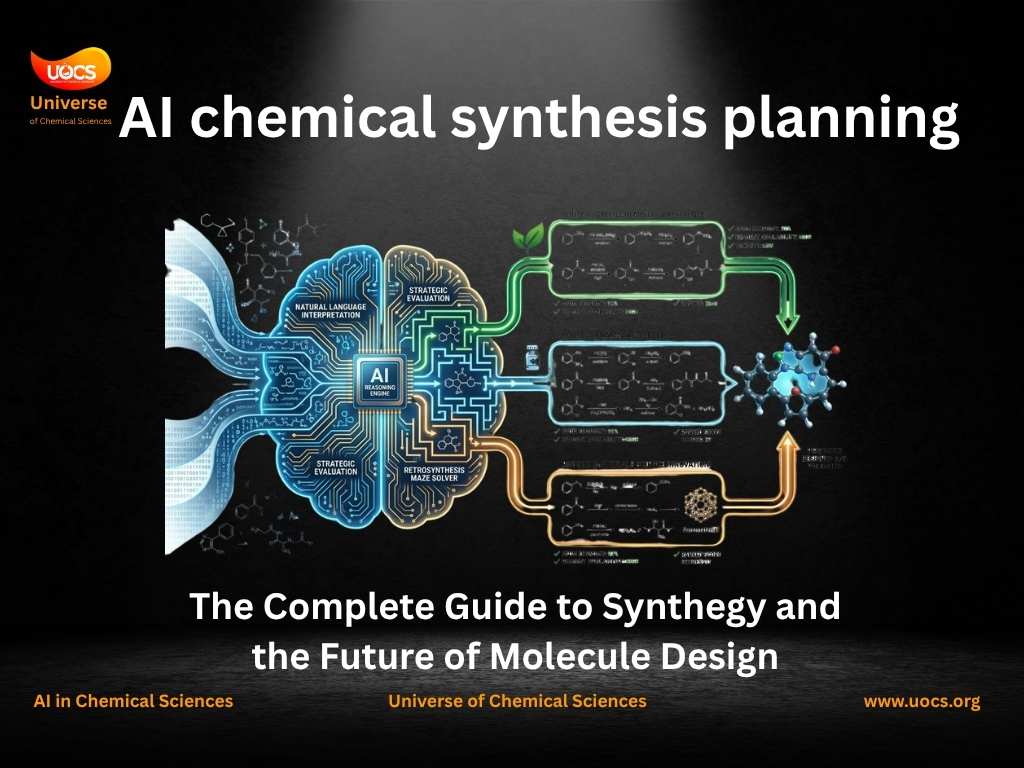
The traditional paradigm of computational chemistry has long relied on structural graph theory and three-dimensional coordinate matrices. While these spatial representations are mathematically precise for molecular mechanics, they impose severe computational bottlenecks when scaled to modern generative AI architectures. The emergence of Chemical Language Models (CLMs) / Molecular Tokenization and SMILES Strings has introduced a radical alternative: treating chemical structures not as physical matrices, but as linear sequence syntax.
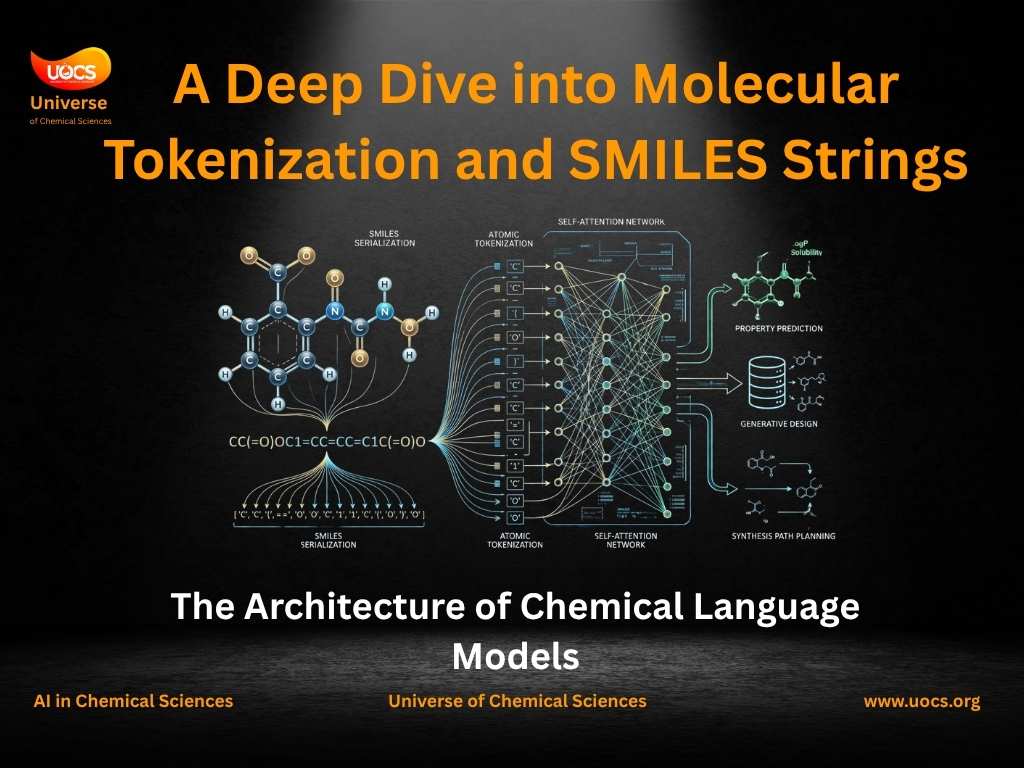
By leveraging Transformer architectures—originally designed for Natural Language Processing (NLP)—CLMs treat molecules like text sentences. At the core of this methodology is the process of translating structural chemical graphs into standardized text syntax, a framework governed entirely by molecular tokenization and SMILES strings. This technical guide breaks down the underlying mechanics of string serialization, token attention mapping, deep-learning tokenization algorithms, and how neural network architectures decode the foundational grammar of organic chemistry.
1. Graph-to-String Serialization: Decoding SMILES and Beyond
To process a molecule within a sequence-to-sequence deep learning model, a multi-dimensional molecular graph—where vertices represent atoms and edges represent chemical bonds—must be flattened into a one-dimensional array of text characters. The most prevalent standard for this serialization is SMILES (Simplified Molecular Input Line Entry System), alongside modern alternatives like SELFIES (Self-Referencing Embedded Strings).
The Mechanics of SMILES Generation
SMILES uses a depth-first graph traversal algorithm to convert a molecular structure into an ASCII string. The graph vertices (atoms) become characters, and edges (bonds) are represented by specific syntactic symbols:
Atom Representation: Standard organic elements are denoted by their atomic symbols (e.g.,
C,N,O,P,S). Aromatic atoms are converted to lowercase (c,n,o) to denote delocalized electron systems. Non-standard elements or atoms with explicit hydrogen counts, charges, or isotopic masses are enclosed in square brackets (e.g.,[NH4+],[13CH4]).Branching Syntax: Branches off a main molecular chain are enclosed in parentheses
(). For example, propanoic acid is serialized asCCC(=O)O, where the carbonyl oxygen is explicitly marked as a branch. Nesting branches within branches is represented by nested parentheses, such asCC(C)(C)Cfor neopentane.Ring Closure Integration: To represent cyclical structures, the algorithm breaks a ring bond and inserts an identical integer at both rupture points. Benzene, therefore, scales from a hexagon graph to the linear syntax
c1ccccc1. For highly complex fused rings or polycyclic networks, multiple distinct integers are utilized sequentially (e.g.,1,2,3).
The Canonicalization Challenge
A major structural hurdle in using SMILES for machine learning is that a single molecule can often be represented by dozens of valid SMILES strings depending on which atom the graph traversal begins with. For instance, aspirin can be written in over a hundred variations.
Aspirin (Uncanonicalized Variation A): CC(=O)OC1=CC=CC=C1C(=O)O
Aspirin (Uncanonicalized Variation B): O=C(O)c1ccccc1OC(=O)C
Aspirin (Deterministic Canonical Form): CC(=O)Oc1ccccc1C(=O)O
CLMs require canonicalization—running the string through a deterministic algorithm (such as the CANGS or Morgan algorithm within RDKit) to ensure a strict 1-to-1 mapping between a unique chemical structure and a unique text string. Without canonicalization, an AI model would treat different string representations of the exact same molecule as entirely unique data points, heavily diluting the model’s weight optimization during training.
2. Molecular Tokenization: Preparing Chemical Syntax for the Transformer
Once a canonical SMILES string is generated, it cannot be fed directly into a Transformer. It must first undergo tokenization, splitting the raw string into discrete numerical vectors (tokens) that form the vocabulary of the model.
In chemical deep learning, tokenization strategies broadly fall into three categories:
Character-Level Tokenization
This approach treats every individual text character as an independent token. While simple to implement, character-level tokenization introduces severe semantic fragmentation. For example, a chlorinated compound containing Cl is split into a C token and an l token. The model is forced to learn that a capital C followed by a lowercase l represents chlorine, rather than a carbon atom adjacent to an undefined element. Similarly, multi-character syntax like ring numbers 10 or explicit isotopes [13CH4] become completely detached from their physical chemical meaning.
Atom-Level Regex Tokenization
To fix the limitations of character-level splitting, modern cheminformatics pipelines use specialized Regular Expressions (Regex) designed for chemistry. This method treats entire multi-character atomic symbols, bracketed expressions, and explicit bond markings as single tokens.
Python
# Typical Cheminformatics Regex for SMILES Tokenization
SMILES_REGEX = r"( ![\[[^\]](https://uocs.org/wp-content/ql-cache/quicklatex.com-b802080b954ff496c155b88cf16659a3_l3.png "Rendered by QuickLaTeX.com")
]+\]|Br?|Cl?|N|O|S|P|F|I|b|c|n|o|s|p| |\.|=|#|-|\+|\\|\/|:|~|@|\?|>|\*|\d+)"
Using this regex, the string CC(Cl)=O is cleanly broken down into seven distinct semantic tokens: ['C', 'C', '(', 'Cl', ')', '=', 'O']. This ensures that the downstream neural layers receive inputs that map accurately onto discrete chemical entities.
Byte-Pair Encoding (BPE) in Cheminformatics
For large-scale structural text models, tokenization has evolved to include Byte-Pair Encoding (BPE), the same algorithm used by modern conversational engines. BPE analyzes millions of chemical strings and compresses frequently co-occurring sub-sequences into a single token.
For example, if a dataset contains thousands of carboxylic acid groups (C(=O)O), BPE merges these separate symbols into one unified functional group token. This significantly reduces the sequence length of long polymer chains or complex macrocycles, allowing the model to process larger molecular payloads without exceeding its context window limits.
3. Attention Mechanisms and the “Grammar” of Chemistry
At the heart of Chemical Language Models is the Self-Attention mechanism, identical to the multi-head attention layers powering advanced LLMs. In an NLP context, self-attention allows a model to calculate how much a specific word in a sentence relies on every other word to establish context. In a CLM, self-attention maps the structural dependencies between distant atoms.
[C] <--> [C] <--> [C] <--> [(=O)] <--> [O]
 ^_______________________________________^
     Self-Attention Dependency Mapping
Learning Chemical Valence Rules
When a CLM is trained via self-supervised masked language modeling (where certain tokens are hidden, and the AI must predict them), it implicitly learns the laws of chemical valence without ever being programmed with textbook rules.
The model learns that a
Ctoken can only accommodate four single-bond equivalents.It recognizes that an open parenthesis token
(must always eventually pair with a closing parenthesis token).It understands that if a ring index token
1appears, it must be followed by a matching1token later in the sequence to close the ring graph safely.
Capturing Electronic and Non-Local Effects
Crucially, self-attention allows the model to capture non-local electronic effects, such as induction and resonance. An aromatic ring token at the beginning of a long SMILES string can alter the token probabilities of a functional group located thirty tokens away. This capability allows frameworks like Synthegy to execute high-level chemical reasoning; by reading the token interactions, the AI evaluates whether a specific reaction pathway is strategically viable or if electronic conflicts will cause the synthesis route to fail.
4. Advanced Vector Space: Latent Embeddings and Property Mapping
When a molecule is fully tokenized and passed through the self-attention layers of a molecular tokenization and SMILES strings pipeline, it is transformed into a high-dimensional vector known as a latent embedding. This embedding is a mathematical representation of the entire molecule’s structural, electronic, and functional properties trapped in a continuous vector space.
The Continuous Molecular Space
In this latent space, molecules with similar chemical configurations or reactivity patterns are naturally clustered together. For instance, if you plot these vectors in a reduced-dimension space (using techniques like t-SNE or UMAP), all halogenated aromatics will cluster in one region, while aliphatic alcohols will gather in another.
   [ Latent Vector Space Mapping ]

   (Aliphatic Alcohols)          (Aromatic Rings)
      [CCO]   [CCCO]               [c1ccccc1]
        \       /                      |
         [CCCCO]                  [c1ccccc1CC]
This vectorization provides an extraordinary shortcut for drug discovery. Instead of spending months running physical laboratory assays or heavy quantum mechanics simulations to test billions of molecules, a machine learning model can compute the cosine similarity between molecular vectors in milliseconds to predict target interactions.
Downstream Property Prediction
By attaching a simple linear neural network layer to the output of these latent embeddings, researchers can train the model to perform highly accurate quantitative structure-activity relationship (QSAR) modeling. The language model acts as a feature extractor, passing the structural meaning of the SMILES text string directly to a predictive head that outputs specific metrics, including:
LogP (Octanol-water partition coefficient)
Solubility (ESOL parameters)
Binding Affinity ($K_i$ or $IC_{50}$ values against specific biological enzymes)
Toxicity Profiles (hERG channel inhibition or Ames mutagenicity)
5. Architectural Limits and the Rise of SELFIES
Despite the massive success of combining molecular tokenization and SMILES strings, the system faces a fundamental limitation: invalid sequence generation.
Because SMILES relies heavily on strict, matching symbols for rings and branches, even a minor token hallucination by the LLM (like forgetting to close a parenthesis or miscounting a ring index) results in a string that cannot be parsed by cheminformatics software. In large-scale generative tasks, up to 30% of an LLM’s output strings can turn out to be chemically impossible junk.
The SELFIES Alternative
To overcome this syntactic fragility, researchers have developed SELFIES (Self-Referencing Embedded Strings). SELFIES re-imagines chemical syntax by building a grammar where every possible combination of tokens automatically maps to a valid molecule.
It achieves this by replacing open-ended ring and branch symbols with formal, rule-based derivation tokens. When a generative model writes a token in SELFIES, the grammar rules automatically evaluate the remaining valence capacity of the current atom. If an AI attempts to attach a fifth bond to a carbon atom, the grammar automatically truncates or reinterprets the token to preserve physical realism.
| Representation System | Syntactic Fragility | Validity Rate in Generative AI | Human Readability |
| SMILES | High (Requires matching brackets/indices) | ~70% – 85% | Moderate (Easy to read manually) |
| SELFIES | Zero (Grammatically locked rules) | 100% (Always physically possible) | Low (Highly abstract code syntax) |
While SELFIES completely eliminates invalid outputs during pure molecule generation, SMILES remains the dominant choice for structural evaluation engines like Synthegy due to its compact syntax, processing efficiency, and massive footprint in legacy chemical literature databases like PubChem and ChEMBL.
6. Training Paradigms: From Self-Supervision to Retrosynthesis
To make a language model truly understand chemistry, it must undergo specific training phases designed to maximize its structural comprehension.
Phase 1: Masked Language Modeling (Pre-training)
In this initial step, the model is fed hundreds of millions of raw SMILES strings from public repositories. The training algorithm randomly masks out 15% of the tokens. For example, the string CC(=O)O might be presented as CC([MASK])O. By adjusting its internal attention weights to minimize cross-entropy loss, the model learns to fill in the blank, gaining a foundational intuition for functional group patterns, atomic connectivity, and chemical logic.
Phase 2: Sequence-to-Sequence Translation (Fine-tuning)
Once the model understands basic syntax, it is transitioned to a sequence-to-sequence (Seq2Seq) architecture for complex reasoning tasks like retrosynthesis. In this phase, the task is framed as a literal translation problem—similar to translating English to French.
Target Input String (The Product):  CC(=O)Oc1ccccc1C(=O)O
      === (CLM Translation Layer) ===
Source Output String (The Reagents): CC(=O)Cl . Oc1ccccc1C(=O)O
The model reads the product string, maps it to its internal structural understanding, and generates a new text string containing the optimal starting blocks separated by a dot (.) delimiter. This sequence-based approach forms the core operational foundation of the Synthegy framework.
Conclusion: The Convergence of Syntax and Synthesis
By shifting from rigid spatial graphs to flexible text sequences, chemical language models have fundamentally altered the computational chemistry landscape. Understanding the deep mechanics of molecular tokenization and SMILES strings reveals that chemistry is not just bound by physical laws—it is organized by a predictable, text-based structural syntax.
As sequence models grow more sophisticated and incorporate cleaner atom-attention metrics, our ability to converse with, predict, and engineer novel molecular structures will rely entirely on our mastery of this digital chemical alphabet. The frontier of molecular design is no longer just a physical lab challenge; it is a syntax optimization challenge.
- Published in Matter, April 24, 2026 — DOI: 10.1016/j.matt.2026.102812