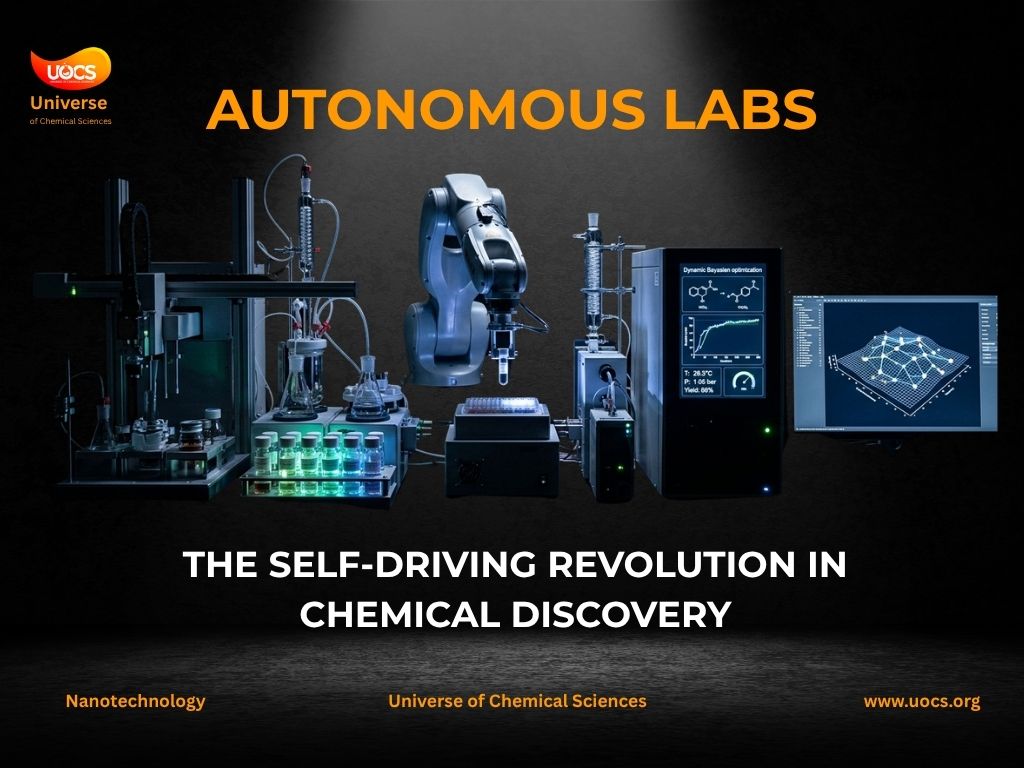
It is 3:00 AM on a Tuesday. In a high-containment facility, a robotic arm moves with precision, drawing a microliter volume of catalyst from a sealed vial. There is no scientist present. There is no one to monitor the temperature sensors or note the reaction yields. Yet, the facility is productive. Through the night, this system completes four full experimental cycles, generating data that would occupy a standard research team for a week. This is not a vision of the future; it is the current operational reality for leading materials research hubs in 2026. The Autonomous Labs!
We define autonomous laboratories as closed-loop research platforms that integrate hardware, analytical instrumentation, and artificial intelligence to execute end-to-end scientific tasks. My experience overseeing transition efforts for chemical departments reveals a stark truth: the field is currently transitioning from a discovery-by-chance model—where researchers rely on heuristics and luck—to a predictive-design model. This article explores the technical foundations of these systems, their industrial implications, and the trajectory of scientific inquiry toward 2030.
2. The Bottleneck: The Human Element in R&D
Traditional chemical research follows a rigid, linear cycle: hypothesis formation, sample preparation, execution, analytical characterization, and refinement. In my observations of large-scale chemical manufacturing, the bottleneck is rarely a lack of equipment; it is the physical limitation of the chemist.
To visualize this, consider the “shovel in the desert” analogy. Chemists estimate the size of the drug-like chemical space to be approximately $10^{60}$ unique molecules. If a research laboratory synthesizes $10^2$ compounds per year—a standard, high-performance output for a human team—they are barely scratching the surface of probability. Furthermore, humans are subject to operational fatigue. Even with the most stringent Standard Operating Procedures (SOPs), manual errors in reagent dispensing or deviations in incubation timing introduce “noise” into the dataset.
Maintaining environmental consistency across a study lasting six months is statistically improbable with human operators alone. When we analyze experimental drift, we find that human-operated labs often exhibit a 15–20% variance in reaction conditions over long-duration trials. Autonomous systems eliminate this variability by maintaining atmospheric, thermal, and mechanical set-points within sub-percent tolerances.
Pro-Tip: Focus on digitizing historical data before investing in robotics. If your lab’s past results reside in paper notebooks or non-machine-readable PDFs, your AI will have no foundation from which to learn.
3. Expert Perspective: Addressing Misconceptions
The most prevalent industry anxiety regarding the autonomous transition is the “replacement myth.” When I consult for academic boards, the fear is palpable: will AI make the chemist obsolete? Based on my analysis, the answer is a categorical no. Instead, the role is shifting toward high-level experimental framing.
The autonomous labs system acts as a specialized tool, but it lacks the creative capacity for goal-setting. Human intuition remains the primary driver of complex ethical oversight and the definition of research parameters. However, I have seen numerous labs fail to transition due to two factors: the sunk cost of legacy manual equipment and the data-silo problem. If your laboratory infrastructure is not interconnected, your automation will remain fragmented. Finally, consider the Capital Expenditure (CapEx) carefully. While the initial investment in robotic infrastructure can range from $500,000 to $3,000,000, the long-term reduction in “time-to-discovery” often provides a return on investment within 24 months, provided the system is utilized at high capacity.
Furthermore, we must address the Ethical Integrity of Data. An autonomous lab generates massive datasets. If the underlying logic of the AI agent is not transparent, we risk creating a “black box” of results that cannot be peer-reviewed. I advocate for Explainable AI (XAI) in every autonomous installation, ensuring that the model’s reasoning for a specific reaction parameter adjustment can be traced back to chemical theory.
Warning: Be wary of vendors promising “turnkey” autonomous solutions. True autonomy requires extensive custom integration to align with your specific chemical workflows.
4. Technical Deep-Dive: Architecture and Mechanisms
At the center of an autonomous lab is the Bayesian Optimization (BO) loop. We model the chemical performance of a reaction as an objective function $f(x)$. The goal is to maximize performance, such as yield or enantiomeric excess, by selecting the optimal vector of experimental conditions, $x$.
The AI agent uses an acquisition function to decide which experiment to run next. The selection follows the formula:
![\[x_{t+1} = \text{argmax}_{x} u(x|D_{1:t})\]](https://uocs.org/wp-content/ql-cache/quicklatex.com-4d89d798d2def2b2e6f659dad4d3ec85_l3.png "Rendered by QuickLaTeX.com")
where $u$ is the utility, and $D_{1:t}$ represents the data accumulated from previous trials.
Comparative Efficiency of Reaction Optimization
| Metric | Human Lab | Automated Screening | Autonomous AI |
| Trials/Week | 10–20 | 500+ | 1,000+ |
| Success Rate | Moderate | High (at scale) | High (with refinement) |
| Optimization | Intuitive | Static | Dynamic |
Autonomous systems use Surface Response Methodology (SRM) to explore the reaction landscape. By adjusting independent variables such as temperature ($T$), pressure ($P$), catalyst concentration ($[Cat]$), and solvent polarity ($\epsilon$), the AI maps the multidimensional surface of the reaction. Studies from 2025 indicate that these agents can converge on optimal reaction conditions with 40% fewer experiments than human-led DOE (Design of Experiments) approaches.
Beyond BO, we are observing the integration of Generative Adversarial Networks (GANs) to propose novel molecular structures. By pairing a generator (which suggests new compounds) with a discriminator (which predicts stability or solubility), the autonomous lab can synthesize compounds that were previously deemed “impossible” due to their complex sterics.
5. Comparative Analysis: Rigid Automation vs. True Autonomy
Distinguishing between Method A (Rigid Automation) and Method B (True Autonomy) is essential for capital allocation.
Method A (Rigid Automation): This involves pre-programmed robotics. It excels at high-throughput screening where the variables are known. However, it is expensive to reconfigure and relies on “brute force” methodology. It cannot pivot if the results suggest a change in strategy.
Method B (True Autonomous Labs): This employs AI-agent orchestration. These systems feature dynamic re-planning and adaptive learning. If the agent detects that the solvent system is inhibiting a specific reaction pathway, it autonomously swaps the solvent for a secondary candidate without waiting for human intervention.
| Feature | Rigid Automation | True Autonomous Labs |
| Flexibility | Low | High |
| Adaptability | None | Real-time |
| Scalability | Medium | High |
In our experience, Method B is superior for exploratory chemistry. While Method A is cost-effective for repetitive testing, it suffers from “dead-ends.” If you are running 500 experiments that are all failing due to an unidentified impurity in the solvent, Method A will complete all 500. Method B will detect the failure at trial 12, pause, analyze the impurity, and recalibrate.
6. Real-World Applications & Global Impact
In the United States and Canada, the pharmaceutical sector is at the forefront of this shift. We are utilizing autonomous platforms for lead optimization, screening thousands of molecular candidates daily to identify binders with high therapeutic indices.
In European R&D hubs, autonomous labs are currently being used to discover novel catalysts for carbon capture. These machines have successfully identified complex metal-organic frameworks (MOFs) that stabilize $CO_2$ at lower pressures than previously documented. Meanwhile, in Japan and South Korea, the focus has shifted toward energy storage. Researchers there are deploying AI-discovered electrolytes for next-generation Lithium-Ion Batteries, achieving faster ionic conductivity by autonomously tweaking the salt-to-solvent ratios in the electrolyte matrix.
Safety Protocols in Autonomous Environments:
When we scale these systems, safety becomes the paramount concern. An autonomous lab must incorporate Haptic-Feedback Sensing in its robotics to prevent spills or mechanical failures. Furthermore, AI agents must be hard-coded with “fail-safe” parameters—for instance, if an exothermic reaction exceeds a defined $\Delta H$ threshold, the system must trigger an automatic quenching protocol without waiting for confirmation.
Pro-Tip: When scaling these applications, prioritize “modular architecture.” Ensure your robotic systems can handle different container types, as this flexibility is the hallmark of a future-proof laboratory.
7. Future Outlook: The 2027-2030 Horizon
By 2027, I anticipate the integration of Large Language Models (LLMs) into the lab control interface. We will move away from writing complex scripts to using natural language programming to initiate research campaigns.
Global decentralization is another trend to watch. We may see the emergence of Cloud-Based Labs-as-a-Service, where researchers in developing nations can rent time on autonomous hardware located in global centers. The inevitable decline of “trial-and-error” as the dominant scientific method is accelerating. By 2030, I predict the emergence of AI-native chemical institutions—organizations where the primary product is not just chemicals, but the data-driven pathways to discover them.
We must also prepare for the Regulatory Shift. As these autonomous labs start producing clinical-grade compounds, regulatory bodies like the FDA will require “Data Lineage Validation”—a full, audit-trail-backed log of every decision the AI made during synthesis.
8. FAQ
What is an autonomous laboratory? An autonomous laboratory is a self-driving research platform that uses integrated robotics and artificial intelligence to perform end-to-end scientific experiments without constant human intervention.
How do autonomous labs improve drug discovery? They improve drug discovery by autonomously iterating through thousands of molecular candidates daily, drastically reducing the time required to move from an initial lead compound to clinical validation.
What role does machine learning play in chemistry? Machine learning serves as the “brain” of the autonomous lab, analyzing experimental data in real-time to adjust reaction parameters and formulate the next set of hypotheses.
Are self-driving labs expensive to implement? Yes, self-driving labs require significant initial capital expenditure for specialized robotics and software infrastructure, though they offer long-term savings by accelerating the discovery cycle.
Will AI replace human chemists in research? AI will not replace human chemists, but it will fundamentally shift the researcher’s role from manual experimentation to high-level strategic oversight and creative problem-solving.
9. Conclusion
The autonomous revolution represents a profound partnership between silicon and synthesis. In our laboratory experience, the systems that succeed are those that view robotics as an extension of the human intellect, rather than a replacement for it. By delegating iterative tasks to autonomous systems, we are clearing the path for the type of high-level scientific inquiry that only humans can navigate.