
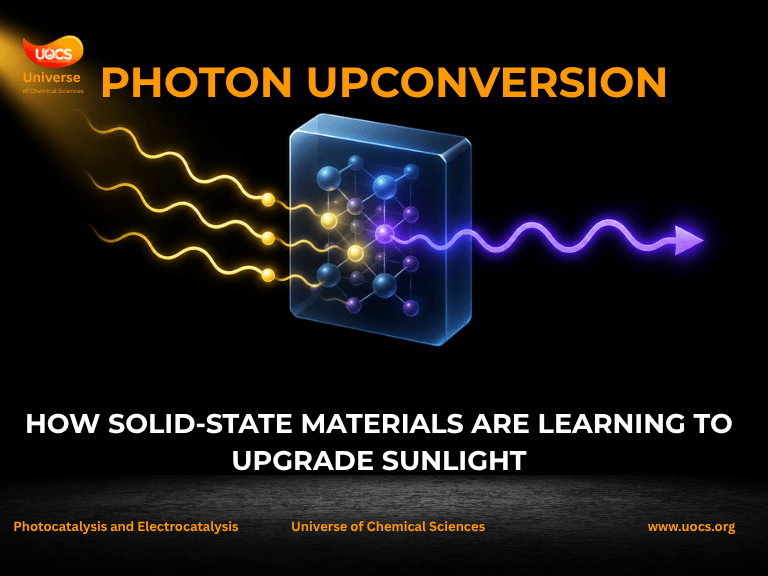
It is midday in Fukuoka, Japan, and ordinary sunlight is falling on a thin, unremarkable-looking film sitting on a laboratory bench. There is no laser. There is no vacuum chamber. There is no sealed, oxygen-free container. Yet within that film, something quietly extraordinary is happening: pairs of low-energy visible light photons are combining and re-emerging as single, higher-energy ultraviolet photons — a transformation that solid-state chemistry has chased, and largely failed to achieve outside the laboratory, for over a decade.
This is photon upconversion, and the June 2026 breakthrough from Kyushu University’s Research Center for Negative Emissions Technologies represents one of the most significant advances in this field to date. This article examines the underlying photophysics, the specific molecular engineering that made air-stable solid-state upconversion possible, the historical arc of research that led here, and where this technology is headed.
2. The Physics of Sunlight: Why Not All Photons Are Equal
To understand why this breakthrough matters, it helps to first understand the energetic structure of sunlight itself. Solar radiation reaching Earth’s surface spans a broad spectrum, but only a narrow slice of it — roughly 3 to 4 percent — falls in the ultraviolet range. The overwhelming majority arrives as visible and infrared light, wavelengths that individually carry insufficient energy per photon to drive many of the chemical reactions that UV light can trigger.
This matters because photon energy is inversely proportional to wavelength: shorter wavelengths, like UV, carry more energy per photon than longer wavelengths, like visible red light. Many valuable photochemical processes — from photocatalytic pollutant breakdown to resin curing to certain forms of solar-driven synthesis — have energy thresholds that only UV photons can cross. Visible light, no matter how abundant, simply cannot do this work directly, because individual visible photons fall below the required energy threshold.
Photon upconversion offers a way around this constraint: rather than requiring a single high-energy photon, upconversion combines the energy of two lower-energy photons to produce one higher-energy photon that can cross the threshold that neither original photon could reach alone.
3. What Is Photon Upconversion, Precisely?
Photon upconversion is a nonlinear optical process in which two or more low-energy photons are combined to generate a single photon of higher energy. In the specific mechanism relevant here — triplet-triplet annihilation (TTA) — a donor chromophore absorbs a visible-light photon and is promoted to an excited singlet state, which undergoes intersystem crossing into a longer-lived triplet state. That triplet energy migrates via Dexter energy transfer to a neighboring acceptor molecule. When two triplet-excited acceptor molecules collide, one is promoted to a higher-energy singlet state while the other returns to the ground state — and the singlet-excited acceptor emits a single photon at a shorter wavelength (higher energy) than either of the two photons that were originally absorbed.
Pro-Tip: TTA-based upconversion should not be confused with lanthanide-based upconversion, which relies on sequential absorption within a single ion’s electronic energy levels rather than intermolecular triplet energy transfer. TTA systems generally achieve higher quantum yields under low, incoherent excitation sources such as ambient sunlight — which is precisely why they are the mechanism of choice for solar applications, whereas lanthanide-based systems typically require concentrated, coherent laser excitation to achieve comparable efficiencies.
4. Intersystem Crossing and the Role of Spin States
To appreciate why triplet states specifically are central to this mechanism, it is worth briefly examining the quantum mechanical concept of electron spin multiplicity. When a molecule absorbs a photon, an electron is promoted from the ground state to an excited state. In most organic chromophores, this initially excited state is a singlet state, in which the excited electron retains a spin paired (antiparallel) with the electron it left behind in the ground-state orbital.
Singlet excited states are typically short-lived, decaying back to the ground state within nanoseconds via fluorescence or non-radiative pathways. For upconversion to work, this singlet-excited energy must first undergo intersystem crossing — a spin-forbidden but quantum-mechanically permitted transition into a triplet state, in which the excited electron’s spin becomes parallel (unpaired) relative to the ground-state electron. Triplet states are considerably longer-lived than singlets, often persisting for microseconds to milliseconds, precisely because the spin-forbidden nature of triplet-to-singlet relaxation slows the return to ground state.
This extended triplet lifetime is essential: it provides sufficient time for the excited triplet energy to migrate through the solid material via Dexter energy transfer — a short-range mechanism requiring direct orbital overlap between neighboring molecules — until it encounters another triplet-excited molecule with which it can undergo annihilation.
5. The Historical Bottleneck: Why Solid-State TTA Failed for So Long
In our review of the upconversion literature, the central obstacle has always been molecular packing density. TTA upconversion requires triplet-excited molecules to be close enough to migrate energy efficiently between neighbors, but not so close that competing non-radiative decay pathways — where excited energy is lost as heat rather than re-emitted as light — dominate.
In solution-based and gel-based systems, this spacing is achieved through simple dilution; the donor and acceptor molecules are free to diffuse and collide at a controllable frequency, and researchers can tune concentration to optimize the balance between productive triplet-triplet encounters and unwanted quenching. In the solid state, however, molecules are fixed in a rigid lattice, with no diffusional freedom to self-optimize this spacing. Achieving the correct intermolecular distance without dynamic diffusion has proven extraordinarily difficult, and most earlier solid-state attempts suffered from either weak triplet transfer (molecules packed too loosely, resulting in insufficient energy migration efficiency) or rapid triplet-triplet quenching without productive annihilation (molecules packed too tightly, where competing non-radiative decay pathways dominate before annihilation can occur).
Nobuo Kimizuka, now Professor Emeritus at Kyushu University, began investigating this exact problem in 2012, exploring photon upconversion through triplet energy migration in self-assembled molecular systems, with the explicit long-term goal of establishing a form of molecular systems chemistry in which self-assembly could perform useful photophysical functions. Progress over the following decade came through solution-based and gel-based intermediate systems, which demonstrated the underlying photophysics but consistently fell short of a genuinely solid, air-stable platform.
6. The Kyushu Solution: Steric Engineering at the Molecular Level
The research team, led by Kimizuka and researcher Yoichi Sasaki, addressed this packing problem directly at the molecular design stage, using an organic semiconductor called dihydroindenoindenedene (DHI).
By attaching alkyl chains to DHI’s sp³-hybridized carbon centers — carbon atoms with four substituents arranged in a fixed tetrahedral geometry — the researchers introduced steric bulk at precisely defined positions around the core π-conjugated system. This is what the researchers describe as a sterically protected π-electron system: the rigid, tetrahedral alkyl substituents act as molecular spacers, holding neighboring DHI units at a fixed, optimized intermolecular distance within the solid film, without relying on any diffusional freedom.
The resulting material achieved a solid-state fluorescence quantum yield exceeding 60 percent — a strong indicator that non-radiative decay pathways were successfully suppressed — and when paired with a suitable donor chromophore sensitive to visible wavelengths, the complete system achieved a 1.9 percent visible-to-UV upconversion efficiency under simulated sunlight.
7. Comparative Performance Analysis
Comparative Performance: Solid-State vs. Solution-Based Upconversion Systems
| Parameter | Solution-Based TTA-UC | Kyushu Solid-State DHI System |
|---|---|---|
| Environment stability | Requires oxygen-free, sealed conditions | Stable in ambient air |
| Operational stability | Degrades within hours in air | Maintained performance beyond 100 hours in air |
| Excitation source | Often requires concentrated/laser light | Functions under natural, low-intensity sunlight |
| Fluorescence quantum yield | Variable, often solvent-dependent | >60% in solid state |
| Manufacturability | Complex, solvent-handling intensive | Straightforward, inexpensive starting materials |
| Deployment format | Liquid cell, requires containment | Thin solid film, directly applicable |
| Handling requirements | Specialized glovebox/inert atmosphere | Ambient laboratory conditions sufficient |
This comparison underscores that the significance of the Kyushu result lies less in the raw efficiency percentage and more in the fundamental shift from a laboratory-bound liquid system to a genuinely deployable solid material.
8. Why Air Stability Is the Real Breakthrough
Warning: Do not evaluate upconversion systems on efficiency percentage alone. A system with 5% efficiency that degrades within an hour of air exposure has essentially zero practical value. A system with 1.9% efficiency that remains stable for over 100 hours in ambient air represents a genuinely deployable platform.
Oxygen is a potent triplet-state quencher — molecular oxygen readily reacts with triplet-excited chromophores, dissipating their energy non-radiatively before productive annihilation can occur, a phenomenon well documented across photochemistry broadly (it is, for instance, the same underlying principle exploited in singlet-oxygen photodynamic therapy). This is precisely why earlier TTA upconversion systems required rigorously deoxygenated, sealed environments; even trace atmospheric oxygen diffusing into a solution-based system would rapidly quench the triplet population responsible for upconversion.
The Kyushu team’s achievement of solid-state stability exceeding 100 hours in ordinary air indicates that the DHI packing architecture provides sufficient physical shielding of the triplet-excited species from ambient oxygen diffusion — a property that solution-based systems, lacking any rigid matrix, simply cannot replicate. The dense, precisely spaced molecular packing that enables efficient triplet energy transfer between DHI units appears to simultaneously restrict the diffusional pathway by which atmospheric oxygen could otherwise penetrate the film and quench the excited states.
9. Validated Real-World Function: UV Resin Curing
To move beyond spectroscopic characterization alone, the research team validated the system’s practical utility by exposing the DHI film to simulated sunlight containing exclusively visible wavelengths, with no artificial UV component. The ultraviolet light generated by the upconversion process was sufficient to cure and solidify a photosensitive resin — a reaction that ordinarily demands direct UV lamp exposure. This is a critical distinction between a laboratory spectroscopic curiosity and a functional photochemical energy source: the film was not merely detected to emit UV photons by a sensitive instrument, but demonstrated to perform genuine chemical work using only those upconverted photons.
10. Applications on the Horizon
Photocatalytic air and water purification. Titanium dioxide and related photocatalysts require UV activation to generate the reactive oxygen species responsible for pollutant and pathogen degradation. A durable upconversion layer integrated with a TiO2 photocatalyst could, in principle, enable purification systems powered entirely by ambient sunlight, without any external UV lamp or electrical input — a particularly compelling prospect for off-grid water purification in regions with limited electrical infrastructure.
Solar-driven industrial UV curing. Coatings, adhesives, and stereolithographic 3D printing resins depend heavily on electrically powered UV lamps, which represent a meaningful and continuous energy cost across manufacturing operations. Passive upconversion films integrated into curing lines represent a plausible pathway to meaningful energy savings in these processes, particularly for outdoor or high-sunlight-exposure manufacturing contexts.
Expanding the useful solar spectrum. Conventional photovoltaic and photocatalytic systems cannot directly exploit the UV-generating potential of visible sunlight. Upconversion technology functionally broadens the accessible solar spectrum for photochemistry, potentially unlocking solar-driven synthetic routes that were previously restricted to specialized UV-equipped laboratories.
Medical and dermatological applications. UV light plays a role in certain therapeutic contexts, including phototherapy for specific skin conditions; solid-state upconversion materials could, in principle, offer a passive, sunlight-driven alternative to dedicated UV lamp equipment in resource-limited clinical settings, though this application remains considerably more exploratory than the industrial use cases above.
11. Remaining Technical Challenges
Despite the significance of this result, several technical challenges remain before widespread deployment becomes realistic. The 1.9 percent efficiency figure, while a genuine milestone for air-stable solid-state systems, remains modest in absolute terms — meaningful scale-up of this technology for applications like large-area water purification would require either efficiency gains through further donor-acceptor chemistry optimization, or applications where even modest UV output delivers proportionally significant value (such as triggering catalytic cycles rather than requiring sustained high-intensity UV flux).
Additionally, while the 100-hour air stability benchmark represents a substantial improvement over prior systems, real-world deployment — particularly outdoor applications exposed to temperature cycling, humidity variation, and prolonged UV self-exposure — will require considerably longer-term stability data before commercial viability can be fully assessed.
12. FAQ
1. What is triplet-triplet annihilation?
It is a photophysical process in which two molecules in an excited triplet state collide, and their combined energy is redistributed such that one molecule is promoted to a higher-energy excited singlet state while the other returns to the ground state — the excited singlet subsequently emits a photon of higher energy than the originally absorbed photons.
2. Why has solid-state upconversion been so difficult to achieve?
Solid-state systems lack the molecular diffusion available in solution, making it difficult to establish the precise intermolecular spacing required for efficient triplet energy transfer without triggering competing non-radiative decay pathways that dissipate the excited energy as heat rather than useful light.
3. Is 1.9% upconversion efficiency significant?
Yes — in the context of a solid-state system operating under unconcentrated natural sunlight and remaining air-stable for over 100 hours, this figure represents a substantial practical advance over prior systems that required sealed, oxygen-free, often laser-excited conditions to achieve any meaningful upconversion at all.
4. What is dihydroindenoindenedene (DHI)?
DHI is an organic semiconductor molecule used as the triplet-accepting chromophore in this system; strategic alkylation of its sp³ carbon centers provides the steric spacing required for efficient solid-state energy transfer while suppressing non-radiative decay.
5. What is intersystem crossing, and why does it matter here?
It is the quantum mechanical transition of an excited molecule from a singlet state to a longer-lived triplet state; this extended triplet lifetime is essential for allowing sufficient time for triplet energy migration to occur before spontaneous decay back to the ground state.
6. What are the next steps for this technology?
Further optimization of donor-acceptor pairing to improve overall upconversion efficiency beyond 1.9%, extended long-term stability testing under realistic outdoor deployment conditions, and integration testing with existing photocatalytic and UV-curing industrial systems.
13. Conclusion
Photon upconversion has long occupied an unusual position in photochemistry — a mechanism whose physics has been understood for decades, yet whose practical, air-stable, solid-state implementation remained elusive despite sustained research effort. The Kyushu team’s steric engineering approach to DHI packing, built on fourteen years of incremental progress in molecular self-assembly research, represents a genuine solution to that packing problem, not merely an incremental efficiency gain. As donor-acceptor chemistries continue to be optimized against this now-viable solid-state platform, the prospect of sunlight-powered UV photochemistry — for purification, curing, and beyond — has moved measurably closer to industrial reality.
References
- Harada, N.; Shoyama, H.; Boonmong, N.; Mizukami, K.; Watanabe, Y.; Zhao, P.; Ehara, M.; Sasaki, Y.; Kimizuka, N. Sterically Protected π-Electron Systems for Efficient Solid-State Photon Upconversion. Nature Communications 2026. DOI: 10.1038/s41467-026-73898-0
- Kyushu University Research Center for Negative Emissions Technologies — Institutional Research Announcement, June 23, 2026.
- Nature Communications Editorial Summary — Photon Upconversion and Molecular Self-Assembly, June 2026.

