
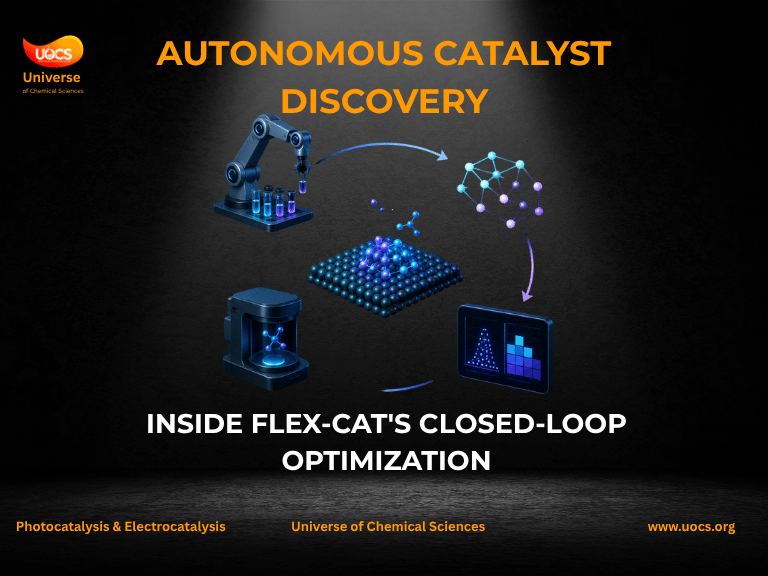
Six hundred and eighty experiments. Sixteen phosphorus-based ligands. Three separate optimization campaigns. Zero manual intervention in the decision loop. This is the operational footprint of Flex-Cat, a self-driving catalysis platform developed at North Carolina State University, and its June 2026 publication in Nature Communications offers one of the clearest demonstrations yet of what autonomous experimentation can uncover that manual screening cannot.
We have written previously about autonomous laboratories as a category. This article is a focused technical deep-dive into a single system, Flex-Cat, and the specific chemistry it discovered: catalysts whose product selectivity can be inverted on command, without changing the catalyst itself.
The Broader Context: Self-Driving Laboratories as a Research Category
Flex-Cat belongs to a rapidly maturing category of research infrastructure often termed self-driving laboratories (SDLs) — autonomous platforms capable of designing, executing, and analyzing experiments with minimal human input. Early-generation SDLs, sometimes retrospectively labeled “SDL 1.0,” demonstrated the basic feasibility of closed-loop robotic experimentation across materials discovery, nanocrystal synthesis, and additive manufacturing optimization throughout the late 2010s and early 2020s.
What distinguishes Flex-Cat and comparable next-generation platforms is the sophistication of the AI decision layer governing experimental selection, combined with integration into industrially representative reaction conditions — high pressure, continuous flow — rather than simplified, discovery-scale-only formats. This positions Flex-Cat within what some researchers term “SDL 2.0” territory: systems designed from the outset with translation to production-relevant conditions as a core objective, not an afterthought.
The Chemistry Problem: Homogeneous Catalysis Optimization
Flex-Cat was designed to optimize homogeneous catalysis — reactions in which the catalyst exists in the same phase (typically dissolved) as the reactants, as opposed to heterogeneous catalysis where a solid catalyst interacts with liquid or gas-phase reactants. The specific system under investigation centered on a rhodium catalyst tuned by phosphorus-based ligands, applied to a hydroformylation-type reaction capable of producing either branched or linear aldehyde products depending on ligand identity and reaction conditions.
Hydroformylation — the addition of a formyl group (CHO) and a hydrogen atom across a carbon-carbon double bond using syngas (a CO/H₂ mixture) — is among the largest-scale homogeneously catalyzed industrial processes globally, used extensively in the production of aldehydes that serve as precursors for plasticizers, detergents, and specialty chemicals. The branched-versus-linear product distinction matters enormously industrially: linear aldehydes are typically the desired product for many downstream applications, while branched isomers are often lower-value byproducts, making selectivity control a central economic concern in industrial hydroformylation.
Conventional catalyst optimization in this space proceeds largely through chemist-directed trial and error: propose a ligand based on electronic and steric intuition, run the reaction, characterize the product distribution, and iterate. Professor Milad Abolhasani, the study’s co-corresponding author, frames the core limitation directly: conventional catalyst discovery is slow, expensive, and heavily dependent on human intuition.
Pro-Tip: When evaluating autonomous catalysis platforms, distinguish between systems that merely automate liquid handling (rigid automation) and systems that incorporate a genuine AI decision loop capable of selecting the next experimental condition based on all prior results (true autonomy). Flex-Cat belongs firmly in the second category, and this distinction is the primary reason it was able to surface findings that purely mechanized but non-adaptive screening would likely have missed.
System Architecture
Flex-Cat integrates four functional layers into a single closed loop:
Robotic liquid handling — prepares reagent and ligand combinations at defined concentrations without manual pipetting, ensuring consistent, reproducible reaction setup across hundreds of sequential experiments without the variability introduced by manual technique differences.
High-pressure flow reactors — execute the catalytic reaction under continuously controlled temperature and pressure, critical for hydroformylation-type chemistry which typically requires elevated syngas pressure; flow reactor formats additionally allow rapid condition switching between sequential experiments without the extended equilibration times associated with traditional batch reactors.
Automated product analysis — characterizes reaction outcomes (product ratio, conversion, selectivity) without requiring a chemist to run or interpret a separate analytical instrument, typically through inline or automated offline chromatographic or spectroscopic analysis integrated directly into the experimental workflow.
AI orchestration layer — ingests the analytical result and selects the next experimental condition to test, closing the loop without human input; this layer implements an active learning strategy, weighing the trade-off between exploring poorly characterized regions of condition space and exploiting known high-performing regions to refine results further.
Abolhasani describes this as an autonomous learning cycle: the system makes a decision, runs the experiment, learns from the outcome, and then chooses the next best experiment.
Experimental Design: Three Campaigns, One Ligand Library
The study screened 16 chemically diverse phosphorus-based ligands across three distinct autonomous optimization campaigns, each targeting a different selectivity objective:
Flex-Cat Campaign Summary
| Campaign | Target Objective | Key Result |
|---|---|---|
| Campaign 1 | Maximize branched aldehyde product | Identified high-branched-selectivity ligand-condition regions |
| Campaign 2 | Maximize linear aldehyde product | Identified high-linear-selectivity ligand-condition regions |
| Campaign 3 | Explore selectivity flexibility range | Discovered condition-programmable selectivity inversion in specific ligands |
Across these campaigns, Flex-Cat achieved greater than 2.5-fold improvements in turnover frequency (a standard kinetic measure of catalytic activity, expressed as reaction cycles completed per active site per unit time) relative to baseline conditions, while simultaneously expanding the accessible regioselectivity range beyond what had been previously mapped for this ligand system.
The choice to run three distinct campaigns rather than a single, undirected screening exercise reflects an important methodological principle in autonomous experimentation: defining clear optimization objectives allows the AI orchestration layer to more efficiently allocate its experimental budget toward regions of condition space genuinely relevant to each goal, rather than diffusing effort across the entire, vastly larger combinatorial space of all possible ligand-condition pairings.
The Key Discovery: Condition-Programmable Selectivity Inversion
The most chemically significant finding was the identification of what the researchers term flexible ligands — phosphorus ligands capable of directing the reaction toward either the branched or linear product, determined not by which ligand is used, but by adjusting reaction conditions such as temperature or pressure around a single fixed ligand system.
This is mechanistically significant because it implies that, for these particular ligand architectures, the rate-determining transition state governing branched-versus-linear selectivity is sufficiently close in energy that modest condition changes can shift the thermodynamic and kinetic balance between competing pathways — a subtlety that would be exceptionally difficult to identify through manual, low-throughput experimentation, since it requires systematically mapping condition space around many ligands simultaneously, a combinatorial task well suited to autonomous, high-throughput execution but poorly suited to manual bench chemistry given time and resource constraints.
Warning: Selectivity-inverting catalyst behavior of this kind can easily be misattributed to experimental noise or impurity effects if only a handful of manual trials are run. The statistical confidence behind this finding derives specifically from the scale (680 experiments) and systematic condition-mapping that only an autonomous platform makes practical — a smaller, manually executed study might well have observed hints of this behavior without being able to distinguish it confidently from run-to-run variability.
Mechanistic Interpretation of Flexible Ligand Behavior
While the study’s primary contribution is empirical — identifying which ligands exhibit condition-programmable behavior — the underlying mechanistic explanation likely relates to competing coordination geometries around the rhodium center. In hydroformylation catalysis, branched-versus-linear selectivity is typically governed by the regiochemistry of alkene insertion into the rhodium-hydride bond, which itself is influenced by the steric and electronic properties of the surrounding ligand environment.
For ligands exhibiting flexible selectivity, it is plausible that two distinct coordination geometries around the rhodium center exist in relatively close energetic proximity, such that modest changes in temperature (affecting the thermodynamic population distribution between geometries) or pressure (affecting syngas coordination equilibria) can shift the dominant reactive pathway. Confirming this mechanistic hypothesis would likely require further spectroscopic or computational investigation beyond the scope of the autonomous screening study itself, representing a natural next research direction building on these empirical findings.
Scale-Up Validation
To confirm findings held beyond discovery-scale microreactor volumes, the research team translated top-performing candidates into a 20 milliliter reactor format — a tenfold volume increase from the original screening scale — and confirmed that performance characteristics carried over. This step matters considerably for industrial relevance; a common criticism of high-throughput discovery platforms is that microscale results frequently fail to translate to production-relevant reactor volumes due to differences in mixing, heat transfer, and mass transport, all of which can behave differently as reactor dimensions scale.
Broader Implications for Autonomous Catalysis
Pharmaceutical process chemistry. Catalyst selection frequently governs the practical viability of a drug synthesis route. Faster, more systematic catalyst discovery — particularly condition-tunable systems requiring fewer distinct catalyst inventories — has direct implications for pharmaceutical manufacturing efficiency, potentially reducing the number of distinct catalytic systems a manufacturer needs to develop, validate, and maintain regulatory documentation for.
Green chemistry alignment. A single flexible catalyst capable of accessing multiple product outcomes through condition adjustment, rather than requiring separate stoichiometric catalyst systems for each product, aligns directly with green chemistry principles around atom economy and waste minimization, reducing the overall chemical inventory and associated waste streams required across a manufacturing operation.
Data-driven structure-performance insight. The autonomously generated 680-experiment dataset provides a foundation for extracting generalizable structure-performance relationships across the ligand library — insight that extends beyond the specific reaction studied and informs future ligand design more broadly, potentially accelerating catalyst discovery efforts in structurally related reaction classes.
Democratizing high-throughput discovery. As autonomous platforms like Flex-Cat mature and associated costs decline, similar closed-loop discovery capabilities may become accessible to a broader range of academic and industrial laboratories currently unable to justify the capital investment associated with first-generation autonomous systems.
Current Limitations
It is worth noting explicitly that Flex-Cat, like all current-generation autonomous platforms, operates within a defined chemical space established by the human research team — the choice of reaction type, the 16-ligand library, and the specific optimization objectives were all human-determined inputs. The system automates experimental execution and condition-selection within that predefined space; it does not independently propose entirely novel reaction classes or hypothesize which chemistries might be worth exploring in the first place. This distinction is important for accurately characterizing the current state of autonomous chemistry, distinguishing genuine current capability from more speculative future extrapolations.
FAQ
1. What distinguishes Flex-Cat from earlier automated screening platforms?
Flex-Cat incorporates an AI decision layer that selects each subsequent experiment based on all prior results, rather than executing a pre-programmed, fixed experimental matrix — this active learning approach distinguishes it from earlier “SDL 1.0” rigid automation systems.
2. What is turnover frequency, and why does it matter?
Turnover frequency measures how many catalytic reaction cycles occur per active catalytic site per unit time — a standard efficiency metric in catalysis, where higher values indicate a more active catalyst capable of processing more substrate per unit of catalyst per unit time.
3. What does “condition-programmable selectivity” mean in practice?
It means a single catalyst system can be directed toward different chemical products simply by adjusting reaction conditions like temperature or pressure, rather than requiring an entirely different catalyst for each desired product — reducing the overall catalyst inventory required for a given manufacturing process.
4. Does Flex-Cat eliminate the need for human chemists?
No — the system automates the repetitive experimental execution and condition-selection cycle within a chemical space defined by human researchers; strategic research direction, chemical hypothesis framing, and interpretation of mechanistic significance remain human-driven functions.
5. How was reliability confirmed beyond the initial screening scale?
Top-performing conditions identified during autonomous screening were validated in a 20 mL reactor, a tenfold scale-up from the original discovery-scale format, confirming that performance characteristics were not artifacts of microscale reaction conditions.
6. What is hydroformylation, and why is branched-versus-linear selectivity important?
Hydroformylation adds a formyl group and hydrogen across a carbon-carbon double bond using syngas; the resulting linear-versus-branched aldehyde product distinction matters industrially because linear isomers are typically the higher-value desired product for many downstream chemical applications.
Conclusion
Flex-Cat demonstrates something more consequential than raw experimental throughput: autonomous systems, run at sufficient scale, can surface catalyst behaviors — like condition-programmable selectivity inversion — that are statistically and practically invisible to conventional, low-throughput manual experimentation. As this class of platform matures and becomes more broadly accessible, the discovery of similarly “hidden” catalytic flexibility across other reaction classes appears not just plausible, but likely, potentially reshaping how the chemical industry approaches catalyst inventory management and process flexibility going forward.
References
- Bennett, J. A.; Orouji, N.; Velayati, A.; et al. An Autonomous Lab for Data-Driven Homogeneous Catalysis. Nature Communications 2026. DOI: 10.1038/s41467-026-74425-x
- North Carolina State University, Department of Chemical and Biomolecular Engineering — Research Announcement, June 23, 2026.
- Technology Networks — Self-Driving Chemistry Lab Accelerates Catalyst Discovery, June 2026.
- This article is the comprehensive technical companion to the InfoChemist.com explainer:This Self-Driving Chemistry Lab Discovers Its Own Catalysts. Read the original news brief at infochemist.com.
- Original research published in: Nature Communications, June 23, 2026 (DOI: 10.1038/s41467-026-74425-x), North Carolina State University.

