
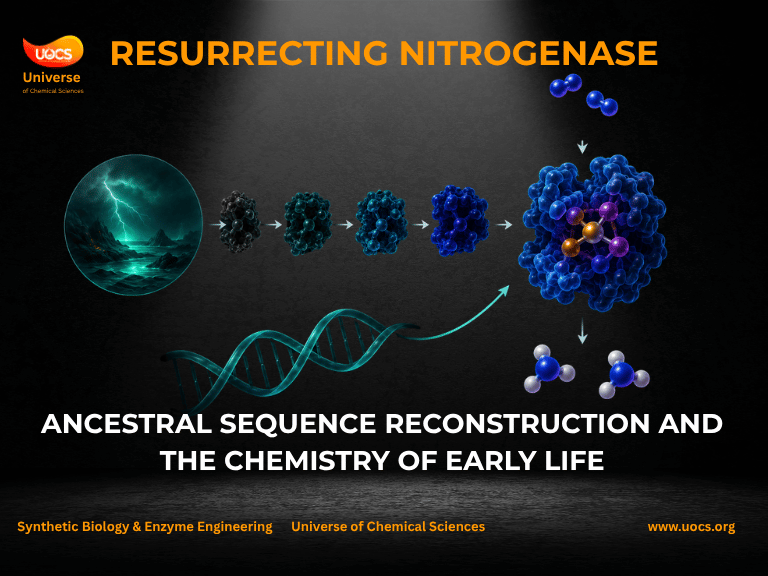
Every nitrogen atom in every protein in every living cell traces its origin back to a single enzymatic reaction: biological nitrogen fixation, catalyzed by nitrogenase. In a study published in Nature Communications in January 2026, researchers at the University of Wisconsin-Madison and Utah State University, working within NASA’s Metal Utilization and Selection across Eons (MUSE) project, reconstructed nitrogenase genes as they likely existed up to 3.2 billion years ago and expressed them inside living bacteria — validating, in the process, one of astrobiology’s most important chemical biosignatures.
2. The Nitrogen Problem in Biology
Nitrogen is essential to every known form of life, forming a core structural component of amino acids, nucleotides, and countless metabolic intermediates. Yet despite constituting nearly 80 percent of Earth’s atmosphere, atmospheric nitrogen exists overwhelmingly as N₂ — a diatomic molecule joined by an exceptionally strong triple bond, among the strongest chemical bonds in nature, with a bond dissociation energy of approximately 941 kilojoules per mole. This triple bond renders atmospheric nitrogen chemically inert to nearly all biological processes; the vast majority of organisms cannot access this enormous nitrogen reservoir directly, despite its abundance surrounding them constantly.
Biological nitrogen fixation — the conversion of inert N₂ into biologically usable ammonia (NH₃) — is accomplished in nature by a remarkably narrow set of organisms, collectively termed diazotrophs, all of which rely on a single enzyme complex to perform this chemically demanding transformation: nitrogenase.
3. Why Nitrogenase Is a Uniquely Powerful Evolutionary Probe
This single-enzyme bottleneck is scientifically valuable precisely because of its uniqueness — unlike carbon or sulfur cycling, which involve numerous parallel and overlapping metabolic pathways carried out by structurally and mechanistically diverse enzyme systems, nitrogen fixation’s dependence on essentially one enzyme system means its evolutionary history can, in principle, be read as a single continuous chemical record, uncomplicated by the interpretive challenges that arise when multiple independent metabolic routes contribute to a single elemental cycle.
That record takes the form of nitrogen isotope fractionation — a measurable difference in the ratio of nitrogen-15 to nitrogen-14 isotopes between atmospheric N₂ and the biomass of organisms that have fixed it. Enzymatic reactions generally discriminate slightly against the heavier isotope during catalysis, producing biomass that is measurably depleted in nitrogen-15 relative to the atmospheric source. This fractionation signature is preserved in ancient sedimentary rock, offering geochemists a proxy for detecting biological nitrogen fixation activity dating back billions of years, even in the complete absence of any preserved fossil evidence of the organisms themselves.
Pro-Tip: Isotope fractionation values are typically expressed in delta notation (δ¹⁵N), reporting the deviation in parts per thousand (‰) from a standard reference ratio, most commonly atmospheric N₂ itself. Modern molybdenum-based nitrogenase produces relatively small negative fractionation values, typically in the range of -1‰ to -3‰, while alternative vanadium- and iron-based nitrogenase isozymes — used by some organisms under molybdenum-limited conditions — exhibit more strongly negative fractionation, in the range of -6‰ to -8‰, a distinction relevant to interpreting which nitrogenase variant was active in ancient ecosystems based on the specific isotopic signature preserved in the rock record.
4. The Unresolved Question
The central uncertainty this study addressed was whether ancient nitrogenases — which differ substantially in amino acid sequence and, to varying degrees, in protein structure from their modern counterparts — would produce the same characteristic isotope fractionation signature as modern nitrogenase. If ancestral enzymes behaved chemically differently from modern ones despite performing the same overall reaction, then isotopic signatures found in ancient rocks could not be reliably interpreted using modern enzyme behavior as a reference point, undermining decades of geochemical interpretation built on the assumption of isotopic constancy across evolutionary time.
This is not merely an academic concern. The oldest geochemical evidence for biological nitrogen fixation comes from nitrogen isotope compositions preserved in approximately 3.2 billion-year-old Archean sedimentary rocks — samples that predate any direct fossil evidence of the microorganisms responsible for producing that isotopic signature. Confirming whether ancient nitrogenase chemistry actually matches modern reference behavior is essential to trusting this interpretation of Earth’s earliest biological activity.
5. Methodology: Ancestral Sequence Reconstruction
The research team employed ancestral sequence reconstruction (ASR), a computational-biochemical technique that proceeds through several defined stages:
Phylogenetic reconstruction — a protein phylogeny of nitrogenase (specifically the nifHDK gene cluster, encoding the three core structural subunits of the nitrogenase enzyme complex) was built by comparing sequences across a wide diversity of modern nitrogen-fixing organisms, mapping the evolutionary relationships between them.
Ancestral node inference — statistical models, typically based on maximum likelihood methods applied to the constructed phylogeny, were used to infer the most probable amino acid sequence at internal nodes of the phylogenetic tree, corresponding to hypothetical ancestral enzymes at defined points in evolutionary history. These internal nodes represent statistically inferred common ancestors, not directly observed historical sequences.
Synthetic gene construction — the inferred ancestral sequences were chemically synthesized as functional genes, using modern DNA synthesis technology to construct genetic sequences that, while never directly observed in nature, represent the field’s best statistical estimate of what those ancient genes actually encoded.
Heterologous expression — these synthetic ancestral genes were inserted into a living host organism, Azotobacter vinelandii, with its native modern nitrogenase genes removed, such that the host’s entire nitrogen supply depended on the reconstructed ancestral enzyme functioning correctly. This is a demanding functional test: an improperly folded or non-functional reconstructed enzyme would simply fail to support the host organism’s growth, providing an immediate and unambiguous indication of reconstruction failure.
Four ancestral nitrogenase variants were engineered, representing a temporal series spanning the present day back to a node dated using heterocystous cyanobacteria fossil evidence as a minimum age constraint — approximately 3.2 billion years, anchoring the oldest reconstructed node to this independently verified geological timepoint.
6. The Fossil Anchor Point
The use of heterocystous cyanobacteria as a minimum age constraint deserves further explanation, as it is central to the study’s dating methodology. Heterocysts are specialized, differentiated cells found in certain filamentous cyanobacteria, dedicated specifically to nitrogen fixation and structurally distinct from the organism’s other photosynthetic cells — this specialization exists precisely because nitrogenase is highly sensitive to oxygen, and heterocysts provide a physically isolated, low-oxygen cellular compartment in which the oxygen-sensitive nitrogenase enzyme can function without being damaged by the oxygen produced during photosynthesis in the organism’s other cells.
Because heterocyst-forming cyanobacteria appear in the fossil record at an identifiable point in evolutionary history, and because heterocyst differentiation itself represents a derived evolutionary innovation built specifically to support nitrogen fixation, their fossil appearance provides a reasonably confident minimum age boundary for placing corresponding nodes on the nitrogenase phylogenetic tree.
7. Results: Isotopic Consistency Across Deep Time
Nitrogen Isotope Fractionation Across Reconstructed Nitrogenase Ancestors
| Nitrogenase Variant | Approximate Age | Isotope Fractionation Pattern |
|---|---|---|
| Modern Mo-nitrogenase | Present day | Established reference fractionation |
| Ancestral node 1 | ~hundreds of millions of years | Consistent with modern pattern |
| Ancestral node 2 | ~1+ billion years | Consistent with modern pattern |
| Ancestral node 3 (oldest tested) | ~3.2 billion years | Consistent with modern pattern |
As lead author Holly Rucker described the outcome: as you step back in time, the DNA sequences of these ancient nitrogenases are very different than modern nitrogenases, and the enzyme structure varies with age — yet these ancient enzymes still do the same chemistry as their modern descendants. Despite substantial sequence and structural divergence across roughly two billion years of reconstructed evolutionary history, the core isotope fractionation chemistry remained functionally stable across every tested ancestral node.
Warning: This finding should not be interpreted as evidence that nitrogenase’s protein structure is evolutionarily static — sequence and structural variation across the reconstructed ancestors was substantial, consistent with billions of years of accumulated evolutionary divergence. What remained conserved specifically was the isotopic fractionation output of the catalytic mechanism, not the protein architecture itself; this distinction between conserved function and divergent structure is central to correctly interpreting the study’s significance.
8. Significance for Reading Earth’s Geological Record
With this isotopic stability validated across roughly two billion years of nitrogenase evolution, geochemists gain substantially stronger confidence in interpreting nitrogen isotope signals recovered from Archean-era sedimentary rock — some dating to approximately 3.2 billion years — as genuine evidence of ancient biological nitrogen fixation activity, rather than being confounded by uncertainty over whether ancestral enzyme chemistry might have differed meaningfully from the modern reference used to calibrate these geochemical interpretations.
This has direct implications for reconstructing the broader timeline of early life on Earth. If nitrogen isotope fractionation had proven inconsistent across deep evolutionary time, it would undermine confidence not just in nitrogen-cycle interpretations specifically, but more broadly in the general practice of using modern enzyme behavior as a calibration reference for interpreting ancient geochemical signals — a foundational assumption underlying much of molecular paleobiology.
9. Implications Beyond Earth
The MUSE project’s NASA funding underscores the astrobiological relevance of this work directly. A validated, evolutionarily stable biochemical signature tied to a single, mechanistically well-understood enzyme system provides planetary scientists with a more defensible target for biosignature detection in extraterrestrial samples — whether from Mars sample-return missions currently in development, or future analyses of icy moon environments such as Europa or Enceladus, believed to host subsurface liquid water oceans that could potentially harbor microbial life analogous to Earth’s earliest organisms.
A biosignature that has been experimentally confirmed to remain stable across billions of years of evolutionary divergence is considerably more scientifically defensible as a search target than one whose deep-time consistency remains merely assumed rather than directly tested — a distinction of real practical importance when interpreting ambiguous chemical signals recovered from extraterrestrial samples where no independent confirmation of biological origin may be available.
10. FAQ
1. What is ancestral sequence reconstruction?
A computational-biochemical technique that infers likely ancient gene or protein sequences by statistically analyzing how modern sequences have diverged across a phylogenetic tree, followed by synthesis and functional testing of the inferred ancestral sequence inside a living organism.
2. Why is nitrogenase particularly suited to this kind of study?
Because biological nitrogen fixation is catalyzed by essentially a single enzyme system across all known nitrogen-fixing organisms, its evolutionary history can be interpreted as one continuous chemical record, unlike more metabolically diverse elemental cycles involving multiple independent enzymatic pathways.
3. What host organism was used to express the ancestral genes?
Azotobacter vinelandii, a bacterium whose native nitrogenase genes were removed and replaced with the synthetic ancestral versions, making the organism’s nitrogen supply entirely dependent on the reconstructed ancient enzyme functioning correctly.
4. How old is the oldest nitrogenase variant reconstructed in this study?
Ancestral nodes were reconstructed representing a temporal series spanning up to approximately 3.2 billion years, using heterocystous cyanobacteria fossil evidence as a minimum age constraint to anchor the phylogenetic dating.
5. What is the astrobiological relevance of this research?
A confirmed, evolutionarily stable chemical biosignature strengthens the tools available for identifying evidence of past biological activity in extraterrestrial samples, supporting NASA’s broader search for life beyond Earth in locations such as Mars or the icy moons of the outer solar system.
6. Why does nitrogenase require such specialized cellular protection in some organisms?
Nitrogenase is highly sensitive to oxygen, which irreversibly damages the enzyme; organisms like heterocystous cyanobacteria evolved specialized, physically isolated cellular compartments (heterocysts) specifically to protect the oxygen-sensitive enzyme from the oxygen produced during their own photosynthetic activity.
11. Conclusion
This study represents a rare instance of directly testing, rather than merely assuming, whether a biochemical process that left its mark in Earth’s oldest rocks would behave consistently across billions of years of molecular evolution. By reconstructing and functionally reviving ancestral nitrogenase genes inside living organisms, the research team confirmed that despite substantial genetic and structural divergence, the core catalytic chemistry — and its isotopic fingerprint — remained remarkably stable, reinforcing nitrogen isotope fractionation as one of the more reliable chemical tools available for probing the earliest chapters of life on Earth, and potentially beyond it.
References
- Rucker, H.; Kaçar, B.; et al. Resurrected Nitrogenases Recapitulate Canonical N-Isotope Biosignatures Over Two Billion Years. Nature Communications 2026. DOI: 10.1038/s41467-025-67423-y
- Harris, D. F.; Rucker, H. R.; Garcia, A. K.; et al. Ancient Nitrogenases Are ATP Dependent. mBio 2024. DOI: 10.1128/mbio.01271-24
- University of Wisconsin-Madison — Institutional Research Announcement, January 22, 2026.
- This article is the comprehensive technical companion to the InfoChemist.com explainer: Scientists Rebuilt a 3.2-Billion-Year-Old Enzyme. It Still Works. Read the original news brief at infochemist.com.
- Original research published in: Nature Communications, January 22, 2026 (DOI: 10.1038/s41467-025-67423-y), University of Wisconsin-Madison / Utah State University / NASA MUSE Project.

