
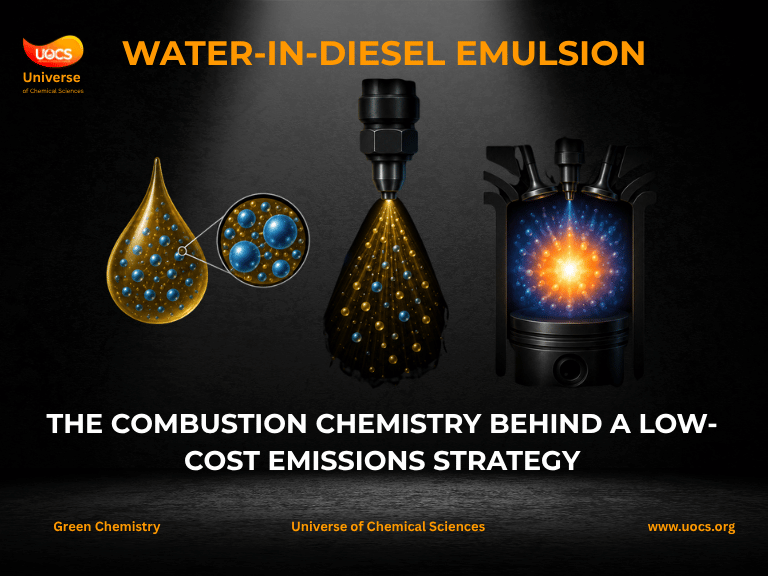
Water is diesel’s oldest enemy — every mechanic’s manual warns against fuel contamination. Yet a substantial and growing body of combustion research, consolidated in a 2025 review published in Carbon Research, demonstrates that deliberately engineered water-in-diesel emulsions can reduce nitrogen oxide emissions by up to 67 percent and particulate matter by up to 68 percent, without any modification to the engine itself. This article examines the combustion chemistry and formulation science underlying this counterintuitive but well-documented approach.
Diesel Engines and the Emissions Challenge
Diesel internal combustion engines remain the dominant power source across heavy transport, marine shipping, agricultural machinery, and stationary power generation, prized for their superior fuel-to-power conversion efficiency and durability relative to gasoline engines. This efficiency advantage, however, comes bundled with a persistent emissions problem: diesel combustion is a major source of nitrogen oxides (NOx), particulate matter (PM), carbon monoxide (CO), unburned hydrocarbons (HC), and sulfur oxides — pollutants collectively linked to respiratory disease, cardiovascular illness, smog formation, and acid rain.
Regulatory pressure to reduce these emissions has intensified globally, driving substantial investment in aftertreatment technologies such as selective catalytic reduction (SCR) and diesel particulate filters (DPF). These systems are effective but expensive, complex, and often impractical to retrofit onto the large existing fleet of older diesel engines still in active service worldwide — creating sustained interest in lower-cost, retrofit-compatible emissions strategies, of which water-in-diesel emulsion is among the most extensively studied.
The Chemistry of NOx Formation in Diesel Combustion
Nitrogen oxide (NOx) formation in diesel engines is governed predominantly by the Zeldovich mechanism (thermal NOx formation), first described by Soviet chemist Yakov Zeldovich, in which atmospheric nitrogen and oxygen react at elevated temperatures within the combustion chamber through a chain of elementary reactions:
N₂ + O → NO + N
N + O₂ → NO + O
This mechanism is strongly temperature-dependent — NOx formation rates increase exponentially above approximately 1,800 Kelvin (roughly 1,530°C), meaning that even modest reductions in peak flame temperature can produce disproportionately large reductions in NOx output, given the exponential rather than linear relationship between temperature and formation rate. This temperature sensitivity is the chemical foundation on which water-in-diesel emulsion (WiDE) technology operates.
Pro-Tip: The exponential temperature dependence of thermal NOx formation means that combustion strategies targeting even a relatively modest reduction in peak flame temperature — on the order of 100–200 Kelvin — can yield NOx reductions considerably larger than a simple linear relationship would predict, which helps explain why relatively small water fractions in emulsified fuel can produce the substantial NOx reductions documented in the literature.
Emulsion Formulation: Surfactant Chemistry
A water-in-diesel emulsion is a dispersed colloidal system in which microscopic water droplets are suspended throughout a continuous diesel phase, stabilized against coalescence and phase separation by surfactant molecules. Surfactants used in WiDE formulations are typically amphiphilic compounds — molecules possessing both a hydrophilic (water-attracting) head group and a lipophilic (oil-attracting) tail — that position themselves at the water-diesel interface, reducing interfacial tension and forming a protective layer around each water droplet that resists the natural thermodynamic tendency of water and oil to separate into distinct phases.
Historical formulation work has explored a range of surfactant systems. Early studies employed combinations such as TWEEN20/SPAN20 and TWEEN80/SPAN80 — nonionic surfactant pairs commonly used across food, pharmaceutical, and industrial emulsion applications — typically using surfactant loadings in the range of 4 to 8 percent by volume to stabilize water fractions of similar magnitude.
Pro-Tip: Emulsion stability is the primary formulation challenge in WiDE technology. Early studies using surfactant combinations such as TWEEN20/SPAN20 or TWEEN80/SPAN80 achieved emulsion stability of only around 8 hours — insufficient for commercial fuel distribution and storage, where fuel may need to remain stable in a tank for weeks between production and combustion. More recent formulations incorporating optimized surfactant blends have extended stability to up to 60 days, a threshold considered necessary for practical commercial deployment.
The Micro-Explosion Mechanism
The core combustion-chemistry phenomenon responsible for WiDE’s emissions benefits is known as micro-explosion. Water has a substantially lower boiling point (100°C at atmospheric pressure) than diesel fuel’s constituent hydrocarbons, which typically span a boiling range considerably higher, and critically, water is encapsulated within each diesel droplet in a stable emulsion, rather than existing as a separate bulk phase. As the emulsified fuel droplet enters the high-temperature combustion chamber environment, the encapsulated water reaches its boiling point and undergoes explosive phase transition to vapor considerably faster than the surrounding diesel combusts, given water’s much lower volatility threshold relative to the hydrocarbon matrix surrounding it.
This rapid, localized vapor expansion physically ruptures the parent diesel droplet from within, fragmenting it into a much finer secondary droplet population — a phenomenon documented extensively in combustion literature on emulsified fuels dating back several decades. Two combustion-relevant consequences follow directly:
Increased surface-area-to-volume ratio — finer atomization dramatically increases the fuel surface area exposed to oxygen, promoting more complete combustion and correspondingly reducing unburned particulate carbon (soot) formation, since soot formation is strongly associated with fuel-rich, oxygen-poor combustion zones that finer atomization helps eliminate.
Endothermic heat absorption — the phase transition of water from liquid to vapor is strongly endothermic (requiring approximately 2,260 kilojoules per kilogram at standard pressure, the latent heat of vaporization of water), drawing thermal energy from the immediate combustion environment and directly suppressing local peak flame temperature — the primary lever controlling thermal NOx formation via the Zeldovich mechanism described above.
Quantitative Emissions Performance
WiDE Emissions Performance Across Reviewed Studies
| Parameter | Reported Range | Best-Case Reduction |
|---|---|---|
| NOx emissions | 21%–67% reduction | Up to 67% |
| Particulate matter | Variable, generally decreased | Up to 68% |
| CO emissions | Often increased | N/A (tradeoff) |
| Unburned hydrocarbons | Often increased | N/A (tradeoff) |
| Brake thermal efficiency | Improved in several formulations | Positive gain reported |
Water content in reviewed formulations typically ranged from 2 to 10 percent by volume. Injection at the compression stroke has been shown to produce NOx reductions as high as 55.6 percent in specific engine configurations, while broader load-range testing across 15–75 percent engine load reported reductions in the 21–40 percent range depending on water content and operating parameters, indicating that the magnitude of NOx reduction is sensitive to both formulation composition and the specific operating regime of the engine.
Warning: The reported increases in carbon monoxide and unburned hydrocarbon emissions across several studies represent a genuine formulation tradeoff, not a reporting inconsistency. This underscores that WiDE functions most effectively as one component of a broader emissions-control strategy rather than a comprehensive standalone solution — a formulation optimized purely to minimize NOx may inadvertently worsen CO and HC emissions if water content or surfactant chemistry is not carefully balanced against combustion completeness requirements.
Injection Pressure and Formulation Optimization
Beyond water content and surfactant chemistry, injection pressure has emerged as an additional variable influencing WiDE performance. One study investigating a hydrophilic emulsion formulation optimized specifically for engine operating temperatures — addressing storage stability challenges that most prior studies had focused on — found that NOx and smoke emissions decreased with increasing injection pressure, with maximum reductions of 32.6 percent and 51.9 percent respectively observed at 210 bar injection pressure. This suggests that combining optimized surfactant formulation chemistry with tuned injection system parameters may yield emissions improvements beyond what either variable could achieve independently, pointing toward a more integrated, systems-level approach to WiDE optimization going forward.
Practical and Economic Advantages
Unlike selective catalytic reduction (SCR) systems or diesel particulate filters (DPF), which require substantial capital investment, dedicated onboard infrastructure, and are frequently impractical to retrofit onto older diesel engines, WiDE requires no engine hardware modification. The emulsified fuel is simply substituted for conventional diesel at the point of fueling, making it a comparatively low-barrier emissions intervention — particularly relevant for aging diesel fleets in agriculture, marine shipping, and remote power generation where SCR/DPF retrofitting is often economically unfeasible given the capital cost relative to the remaining service life of the equipment.
Additionally, water addition reduces the effective volumetric diesel content of the fuel blend, which in some formulations contributes to a modest reduction in overall diesel fuel consumption per unit of engine output, alongside the emissions benefits described above — though this fuel economy effect varies considerably across studies and formulation types and should not be treated as a universally guaranteed benefit.
Current Limitations and Research Directions
Formulation optimization remains an active research area, particularly regarding surfactant selection for extended storage stability, optimal water percentage across varying engine load profiles, and mitigation of the documented CO/hydrocarbon emissions tradeoff. Ongoing research into injection pressure optimization, as described above, suggests that combining formulation chemistry with injection system parameters may yield further emissions improvements beyond formulation changes alone, representing a promising direction for continued research.
Additional open questions include the long-term effects of water-in-diesel emulsions on engine component wear and corrosion, particularly for fuel injection system components exposed to the emulsified fuel over extended operational periods, and the scalability of emulsion production infrastructure required to support widespread commercial adoption beyond research and pilot-scale demonstrations.
FAQ
1. Why does adding water to diesel reduce NOx emissions?
Water’s endothermic vaporization inside the combustion chamber lowers peak flame temperature, directly suppressing the temperature-dependent Zeldovich mechanism responsible for thermal NOx formation, which increases exponentially above roughly 1,800 Kelvin.
2. What is a micro-explosion in combustion chemistry?
It is the rapid, explosive vaporization of water encapsulated within a diesel fuel droplet, which physically fragments the droplet into finer secondary droplets, improving fuel-oxygen mixing and combustion completeness.
3. Does water-in-diesel emulsion require engine modification?
No — WiDE is compatible with existing, unmodified diesel engines, distinguishing it from aftertreatment systems like SCR or DPF which require dedicated onboard hardware and, in many cases, significant retrofit costs for older engines.
4. What are the drawbacks of water-in-diesel emulsion technology?
Several studies report increased carbon monoxide and unburned hydrocarbon emissions as a tradeoff, along with ongoing challenges around long-term emulsion storage stability and potential effects on fuel system component wear.
5. How long can water-in-diesel emulsions remain stable before use?
With optimized surfactant formulations, stability of up to 60 days has been achieved, a significant improvement over early formulations stable for only around 8 hours, though this remains an active area of ongoing formulation research.
6. Does injection pressure affect WiDE performance?
Yes — research indicates that increasing injection pressure can further reduce NOx and smoke emissions in emulsified fuel systems, with maximum documented reductions of 32.6% and 51.9% respectively observed at 210 bar injection pressure in one study.
Conclusion
Water-in-diesel emulsion technology exemplifies how a deceptively simple chemical intervention — introducing water into a fuel it was long assumed to contaminate — can be engineered, through careful surfactant chemistry and combustion physics, into a genuinely effective emissions-reduction strategy. While formulation tradeoffs and stability challenges remain active areas of research, the combustion chemistry underlying WiDE’s NOx and particulate reductions is well-documented and mechanistically sound, positioning it as a practical, infrastructure-compatible bridge technology for the substantial diesel fleet that will remain in operation for years to come.
References
- Advancements in Diesel Emission Reduction Strategies: A Focus on Water-in-Diesel Emulsion Technology. Carbon Research 2025. DOI: 10.1007/s44246-025-00210-y
- Investigation of Water-in-Diesel Emulsion Behavior Formulated for Performance Conditions in a Single-Cylinder Diesel Engine. Energies (MDPI) 2025. DOI: 10.3390/en18040934
- Current Trends in Water-in-Diesel Emulsion as a Fuel. PMC — National Institutes of Health.
- This article is the comprehensive technical companion to the InfoChemist.com explainer: Adding Water to Diesel Fuel Cuts Pollution. Here Is the Chemistry. Read the original news brief at infochemist.com.
- Original research published in: Carbon Research, 2025 (DOI: 10.1007/s44246-025-00210-y).

