
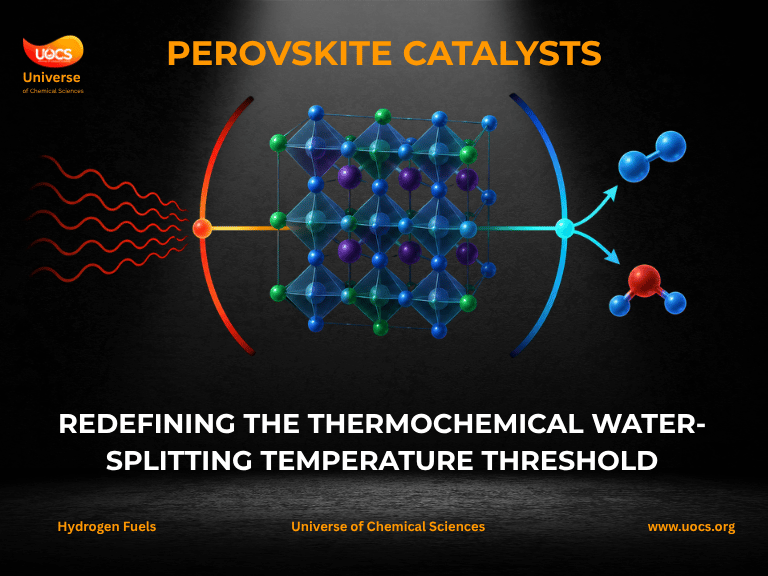
Conventional thermochemical water splitting has been chemically constrained by a stubborn requirement: temperatures exceeding 1,300°C. A research team at the University of Birmingham’s School of Chemical Engineering, led by Professor Yulong Ding, has now demonstrated a perovskite catalyst formulation capable of operating within a 150–500°C window — a reduction of approximately 500 degrees Celsius — with direct implications for the cost structure of clean hydrogen production globally.
The Hydrogen Economy’s Uncomfortable Reality
Hydrogen is frequently described as a cornerstone of the low-carbon energy transition, and for good reason: as a fuel, it produces only heat and water upon combustion, with no direct carbon emissions at the point of use, and it can additionally power fuel cells that generate electricity through electrochemical rather than combustion processes. This clean-burning profile has driven enormous policy and investment interest in hydrogen across transportation, industrial, and grid-storage applications.
Yet the uncomfortable reality underlying current hydrogen production is that approximately 95 percent of global hydrogen supply still derives from fossil fuels, predominantly through steam methane reforming, a process that releases substantial carbon dioxide in the course of manufacturing a fuel intended, ultimately, to help eliminate fossil carbon emissions elsewhere in the energy system. This gap between hydrogen’s clean-burning potential and its carbon-intensive current production reality has become one of the central practical obstacles facing the broader hydrogen economy.
Water Splitting as a Fossil-Free Alternative
Water splitting — the direct decomposition of water molecules into their constituent hydrogen and oxygen — offers a pathway to hydrogen production that avoids fossil fuel dependency entirely. Several distinct water-splitting technologies exist, each with different energy input requirements and technological maturity levels:
Electrolysis (used in “green hydrogen” production) uses electrical current to directly split water molecules, and is the most commercially mature fossil-free water-splitting technology currently deployed at scale, though its cost is fundamentally tied to the price of the renewable electricity used to power it.
Thermochemical water splitting uses heat, rather than electricity, to drive a catalyst-mediated redox cycle that decomposes water into hydrogen and oxygen. Among available water-splitting techniques, thermochemical splitting stands out for its scalability, but its reliance on extremely high temperatures — conventionally exceeding 1,300°C — has significantly limited its widespread industrial adoption, since sustaining such temperatures at scale is both energy-intensive and places substantial demands on the durability of reactor materials and catalyst systems.
The Birmingham team’s work addresses this thermochemical temperature bottleneck directly.
Thermochemical Water Splitting: The Underlying Chemistry
Thermochemical water splitting decomposes water into hydrogen and oxygen through a redox cycle conducted by a metal oxide catalyst material, typically executed in two distinct temperature-dependent steps:
Reduction step (high temperature) — the catalyst material releases lattice oxygen, generating oxygen vacancies within its crystal structure, typically accompanied by release of O₂ gas. This step requires the highest temperature input in the overall cycle.
Oxidation step (lower temperature) — the oxygen-deficient catalyst is exposed to water vapor (H₂O), which donates oxygen atoms to refill the catalyst’s lattice vacancies, releasing the water’s hydrogen content as H₂ gas in the process.
This two-step redox cycle avoids the need to heat water directly to the extreme temperatures (above 2,500°C) that would be required for direct thermal water dissociation without any catalyst intermediary, instead distributing the overall energy requirement across a catalyst-mediated cycle that, while still energy-intensive, operates at achievable industrial temperatures. The practical bottleneck, historically, has always been the temperature required specifically for the catalyst’s reduction step.
Pro-Tip: Thermochemical water splitting should not be confused with electrolysis (used in green hydrogen production) or steam methane reforming (used in conventional gray/blue hydrogen production). It represents a distinct third pathway, historically limited by its extreme temperature requirements rather than by electricity cost (as with electrolysis) or fossil carbon input (as with steam methane reforming).
Perovskite Materials as Redox-Active Catalysts
Perovskites — materials sharing the general crystal structure ABO₃, where A and B represent different metal cation sites within an oxygen-coordinated lattice — are of particular interest for thermochemical redox cycling due to their capacity to undergo reversible, non-stoichiometric oxygen loss and uptake without collapsing their fundamental crystal architecture. This property, termed oxygen non-stoichiometry, allows perovskites to function as reusable oxygen “sponges” across repeated redox cycles, absorbing and releasing oxygen atoms from their lattice structure without the material itself breaking down structurally over many operational cycles — an essential property for any catalyst intended for sustained industrial deployment rather than single-use application.
The most widely studied thermochemical water-splitting catalyst prior to this work has been ceria (cerium dioxide, CeO₂)-based systems, which, while effective, require operating temperatures at the upper end of the conventional 1,300°C+ range described above. The search for lower-temperature alternative catalyst chemistries has been an active research priority precisely because of the substantial energy cost savings a reduced operating temperature would represent.
The BNCF Formulation
The Birmingham team’s formulation, designated BNCF (barium-niobium-calcium-iron oxide), was systematically varied in iron content to identify the composition offering optimal oxygen exchange behavior at reduced temperature. The specific compound investigated, Ba₂Ca₀.₆₆Nb₁.₃₄₋ₓFeₓO₆₋δ, represents a double perovskite structure in which iron substitution at the niobium site was systematically varied (represented by the x subscript) to tune the material’s oxygen exchange thermodynamics.
The optimal variant, BNCF100, demonstrated substantial hydrogen yield across a 150–500°C operating window — compared to greater than 1,300°C for conventional thermochemical water-splitting catalysts such as ceria-based systems, representing an approximately 500°C reduction relative to the incumbent technology.
Catalyst Regeneration and Cyclability
BNCF100 Performance Summary
| Parameter | BNCF100 Performance |
|---|---|
| Hydrogen production temperature range | 150°C – 500°C |
| Catalyst regeneration temperature | 700°C – 1000°C |
| Demonstrated production cycles | 10+ cycles with sustained performance |
| Structural stability | Minimal degradation observed via XRD analysis |
Critically, the catalyst’s regeneration temperature (700–1000°C) remains substantially below the 1,300°C+ threshold required by conventional systems, meaning the entire redox cycle — both oxidation and regeneration steps — operates within a considerably reduced overall thermal envelope compared to incumbent thermochemical water-splitting technology. X-ray diffraction (XRD) analysis conducted across repeated cycling showed minimal structural degradation, indicating the BNCF100 lattice tolerates repeated oxygen loss and uptake without significant crystallographic breakdown — an essential property for any catalyst intended for industrial-scale, multi-cycle deployment, where catalyst degradation over repeated use directly determines the economic viability of the overall process through replacement frequency and associated downtime.
Why the Temperature Reduction Is Economically Significant
Warning: Evaluating this breakthrough purely on temperature reduction alone understates its significance. The 150–500°C operating window falls squarely within the waste heat output range of numerous existing industrial processes — a distinction with direct implications for where and how hydrogen production facilities could be sited, not merely how efficiently they operate.
Foundation industries — steel, cement, glass, and chemical manufacturing — generate substantial waste heat as an unavoidable byproduct of their core operations, heat that frequently falls below the threshold required by most conventional industrial processes and is consequently vented or dissipated without productive use, representing a significant quantity of essentially free thermal energy currently going unexploited across the global industrial base. The BNCF100 catalyst’s reduced operating window brings this previously “too cool to use” waste heat directly into the useful range for hydrogen production, enabling co-located, waste-heat-driven hydrogen generation at existing industrial sites, without requiring dedicated high-temperature heat generation infrastructure specifically for the hydrogen production process itself.
Economic Modeling: Cost Competitiveness
The Birmingham team’s provisional techno-economic analysis found that hydrogen produced via this low-temperature BNCF100 pathway could be delivered at a lower cost than both green hydrogen (electrolysis-based) and blue hydrogen (methane reforming with carbon capture) production routes. This cost advantage was reported as most pronounced in geographic regions characterized by low renewable energy tariffs, such as Australia — locations where cheap renewable electricity or industrial waste heat inputs could feed directly into distributed, locally-sited hydrogen production infrastructure, maximizing the economic benefit of the reduced temperature requirement.
This finding carries an important secondary implication: hydrogen produced and consumed locally at or near its point of generation avoids the substantial cost and infrastructure burden associated with hydrogen storage and long-distance transport — a persistent practical obstacle across the broader clean hydrogen economy, given hydrogen’s low volumetric energy density and specialized storage requirements (typically requiring either high-pressure compression, cryogenic liquefaction, or chemical carrier conversion, each adding cost and complexity to the overall supply chain). Distributed, waste-heat-driven production sidesteps this challenge by minimizing the distance hydrogen must travel between production and end use.
Path to Commercialization
University of Birmingham Enterprise has filed a patent application covering BNCF catalyst use in low-temperature water splitting, with the research team — conducted in collaboration with the University of Science and Technology Beijing — now actively pursuing development partnerships across the UK and European hydrogen sector. This commercialization pathway arrives at a moment when several major global hydrogen infrastructure projects have faced delays or cancellations due to cost overruns, underscoring the sector’s need for genuine cost-reduction breakthroughs at the fundamental chemistry level, rather than incremental engineering optimization alone applied to existing, more expensive production pathways.
Remaining Questions for Scale-Up
While the laboratory-scale demonstration of BNCF100’s performance is well-documented, several questions typically arise when transitioning any catalyst technology from laboratory to industrial scale. These include the behavior of the catalyst material when formed into larger-scale reactor configurations (as opposed to laboratory-scale powder or pellet samples), the practical engineering of heat exchange systems capable of efficiently coupling industrial waste heat streams to the catalyst reactor, and longer-duration cycling studies extending well beyond the 10 cycles demonstrated in the initial published study, to establish confident long-term catalyst lifetime expectations relevant to industrial investment decisions.
FAQ
1. What is thermochemical water splitting?
A two-step redox process in which a metal oxide catalyst releases lattice oxygen at high temperature, then reclaims oxygen from water vapor at a different temperature, releasing hydrogen gas in the process.
2. What makes perovskite materials suitable for this application?
Perovskites can undergo reversible, non-stoichiometric oxygen loss and uptake without structural collapse, allowing them to function as reusable oxygen exchange catalysts across many redox cycles without significant material degradation.
3. How much did the Birmingham catalyst reduce the required operating temperature?
The BNCF100 catalyst enables hydrogen production across a 150–500°C range, compared to over 1,300°C required by conventional thermochemical water-splitting catalysts such as ceria-based systems — a reduction of approximately 500°C.
4. Why does the lower temperature matter economically?
It brings the process within range of industrial waste heat that would otherwise be discarded, enabling co-located hydrogen production and avoiding the transport and storage costs associated with centralized hydrogen manufacturing facilities.
5. How does this compare in cost to green and blue hydrogen?
Provisional techno-economic modeling by the research team indicates this pathway could produce hydrogen at a lower cost than both electrolysis-based green hydrogen and methane-reforming-based blue hydrogen, particularly in regions with low renewable energy tariffs.
6. What was used as the reference catalyst against which BNCF100 was compared?
Ceria (cerium dioxide, CeO₂)-based catalysts, the most widely studied thermochemical water-splitting catalyst system prior to this work, which require operating temperatures at the upper end of the conventional 1,300°C+ range.
Conclusion
The BNCF100 perovskite catalyst addresses thermochemical water splitting’s most persistent limitation directly at the level of catalyst chemistry, rather than through peripheral process engineering. By reducing the operating temperature window by approximately 500°C, this work does not merely make an existing process modestly more efficient — it fundamentally repositions where and how clean hydrogen can be produced, opening industrial waste heat as a genuinely viable, low-cost energy input for a technology long constrained by extreme thermal requirements, and offering a plausible pathway to hydrogen production costs below both established green and blue hydrogen benchmarks.
References
- Chen, B.; Huang, W.; Guo, W.; Tong, L.; Ding, Y.; Wang, L. Remarkable Thermochemical Water-Splitting on Ba₂Ca₀.₆₆Nb₁.₃₄₋ₓFeₓO₆₋δ Perovskites at Medium Temperatures for Hydrogen Production. International Journal of Hydrogen Energy 2026, 236, 152637. DOI: 10.1016/j.ijhydene.2025.152637
- University of Birmingham — Institutional Research Announcement, May 2026.
- EurekAlert! — Water Splitting Catalyst Creates Hydrogen at Low Temperatures, May 2026.
- This article is the comprehensive technical companion to the InfoChemist.com explainer: Perovskite Catalyst Hydrogen Production at 500°C Could Slash Manufacturing Costs. Read the original news brief at infochemist.com.
- Original research published in: International Journal of Hydrogen Energy, 2026 (DOI: 10.1016/j.ijhydene.2025.152637), University of Birmingham.

