
Introduction to Hydrogen Economy Jobs
The global energy transition is unfolding fast, and hydrogen is taking center stage. As governments and companies invest billions into green technologies, hydrogen economy jobs are emerging as one of the most promising career avenues for the future. From engineering and research to logistics and finance, the hydrogen sector is opening up diverse roles that combine innovation with purpose.
In this blog, we explore the booming landscape of hydrogen economy jobs, the skills in demand, and how you can ride this clean energy wave.
What Is the Hydrogen Economy?
The hydrogen economy refers to an energy system that uses hydrogen as a major fuel source, particularly in industries and transportation sectors that are hard to decarbonize. Green hydrogen, produced using renewable energy, is key to reducing global carbon emissions and achieving net-zero targets.
Governments worldwide, from the EU to the U.S. and Japan, are pouring investments into hydrogen infrastructure, making it a critical pillar of the clean energy future—and a fertile ground for employment.
Why Hydrogen Economy Jobs Are the Future
The demand for hydrogen economy jobs is set to soar, and for good reason. Here’s why these careers are rapidly becoming the future of clean energy employment:
Massive Investment Growth
Governments and companies are pouring billions into hydrogen projects. Global demand is expected to quadruple by 2050, creating a surge in job opportunities.
Key to Decarbonization
Hydrogen enables deep decarbonization in hard-to-electrify sectors like steel, aviation, and heavy transport—making it essential for net-zero goals.
Cross-Industry Demand
From energy and manufacturing to logistics and policy, hydrogen jobs span multiple industries, opening doors for diverse skill sets.
Strong Policy Backing
Hydrogen is central to clean energy policies in the U.S., EU, and Asia, ensuring long-term growth and job security.
Purpose-Driven Careers
Jobs in the hydrogen economy let you contribute directly to climate action and sustainable development—making your work impactful and future-proof.
Top Hydrogen Economy Jobs You Shouldn’t Miss
Hydrogen Systems Engineer
Designs and develops systems for hydrogen production, storage, and fuel cell applications.
Key skills: Thermodynamics, fuel cell technology, CAD, system modeling.
Electrolyzer Technician
Operates, maintains, and troubleshoots electrolyzers.
Key skills: Electrical engineering, mechanical maintenance, safety compliance.
Hydrogen Infrastructure Project Manager
Oversees development of hydrogen refueling stations, pipelines, and production plants.
Key skills: Project management, budgeting, regulatory knowledge.
Fuel Cell Scientist
Advances PEM and SOFC technologies.
Key skills: Materials science, electrochemistry, lab research, R&D.
Hydrogen Policy Analyst
Shapes strategies by analyzing regulations, carbon pricing, and policy.
Key skills: Economics, sustainability, policy frameworks, energy modeling.
Logistics and Supply Chain Specialist
Coordinates safe and efficient transport and distribution of hydrogen.
Key skills: Hazardous materials handling, supply chain software, risk management.
Skills Needed to Thrive in the Hydrogen Economy
Even if you’re not an engineer or scientist, there’s room for growth in the hydrogen sector. Here are some valuable skill sets:
| Technical Skills | Soft & Transferable Skills |
| Hydrogen production tech | Critical thinking |
| Fuel cell diagnostics | Problem-solving |
| Data analytics & modeling | Communication |
| GIS & project planning | Adaptability & learning mindset |
Where the Hydrogen Jobs Are
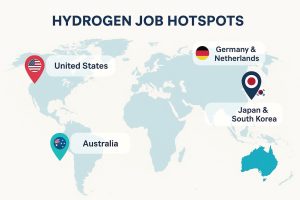
Hydrogen job markets are strongest in countries with national hydrogen strategies and funding commitments. Here are some hotspots:
- United States: Hydrogen Hubs under DOE funding
- Germany & Netherlands: Green hydrogen industrial clusters
- Australia: Export-oriented hydrogen megaprojects
- Japan & South Korea: Focus on hydrogen-powered mobility
Job seekers should watch for growth in engineering firms, energy consultancies, research labs, and startups.
How to Get Started in the Hydrogen Sector
Hydrogen economy doesn’t require decades of experience—just the right steps, skills, and mindset. Here’s how to get your foot in the door:
Research Industry Leaders
Start by exploring key players in the hydrogen space. Companies like Siemens Energy, Plug Power, Air Liquide, Bloom Energy, and Nel Hydrogen are leading innovation in hydrogen production, fuel cells, and infrastructure development. Study their projects, job openings, and sustainability goals.
Build Your Network
The energy transition is a community effort.
- Attend clean energy conferences like Hydrogen Technology Expo or World Hydrogen Summit
- Join LinkedIn groups focused on hydrogen and sustainable energy
- Follow experts and companies on platforms like X (Twitter) and Substack for the latest insights
Upskill and Certify
Gain credentials to boost your relevance. Look for courses or certifications in:
- Hydrogen safety and fuel cell technology
- Electrolyzer operation and maintenance
- Clean energy economics and policy
- Providers like Coursera, IRENA, and Hydrogen Europe often list free or low-cost programs.
Seek Internships and Fellowships
Many government-funded hydrogen projects include internship or fellowship opportunities. Programs run by the U.S. Department of Energy, European Commission, or national labs often recruit students and early-career professionals to work on pilot hydrogen initiatives.
Stay Informed
Subscribe to hydrogen newsletters, read reports from organizations like the Hydrogen Council or IEA, and monitor job boards on platforms such as:
- Hydrogen Central
- Green Jobs Online
- Energy Jobline.
Conclusion: A Career That’s Future-Proof and Impactful
The hydrogen economy is more than a buzzword—it’s a career revolution in the making. As countries double down on clean energy investments, hydrogen is rapidly becoming a cornerstone of industrial decarbonization, energy security, and sustainable innovation. This shift is unlocking a wave of high-impact jobs across engineering, science, logistics, and policy.
Whether you’re a seasoned professional or just starting out, there’s a place for you in this dynamic sector. By upskilling, networking, and staying informed about global hydrogen developments, you can position yourself at the forefront of a clean energy future.
Don’t just watch the energy transition—be a part of it. The hydrogen economy needs bold thinkers, skilled builders, and purpose-driven leaders. Now is your chance to shape not only your career but also the future of our planet.
Read More on Liquid Hydrogen Storage Technologies….
Resources:

