

Introduction to the Future of CCU
Reimagining the Carbon Economy
What if the very gas responsible for heating the planet could also power your car, build your house, or create your clothes?
For decades, carbon dioxide (CO₂) has been seen as public enemy number one in the climate crisis. But what if we’ve been looking at it all wrong?
Welcome to the era of Carbon Capture and Utilization (CCU)—a future where CO₂ isn’t just buried, but transformed into jet fuel, green cement, and everyday consumer goods. Scientists, startups, and entire nations are now racing to turn this once-feared waste gas into a cornerstone of the global green economy.
In this blog, we explore the next-generation CCU technologies, economic disruptions, and global roadmaps that are turning emissions into innovation.
Next-Gen Technologies That Will Define the Future of CCU
The future of Carbon Capture and Utilization (CCU) is being shaped by advanced technologies that push the boundaries of chemistry, engineering, and artificial intelligence. These innovations aim to make CO₂ conversion faster, cheaper, and more scalable—turning a once-stubborn gas into a key building block of the circular economy.
Smart Catalysts and AI-Driven Reaction Design
One of the primary bottlenecks in CO₂ utilization is its chemical stability. Breaking its molecular bonds and reconfiguring them into useful compounds typically requires high energy and specialized catalysts. Enter AI and machine learning, which are revolutionizing catalyst discovery.
AI can simulate millions of molecular interactions, predict catalyst efficiency, and recommend optimal conditions for CO₂ transformation reactions. For example, DeepMind’s AlphaFold-inspired approaches are helping chemists visualize active sites in transition metal complexes, accelerating the design of electrocatalysts for CO₂-to-methanol or CO₂-to-ethylene pathways.
Furthermore, smart reactors integrated with AI feedback loops can dynamically adjust pressure, temperature, and voltage in real-time to optimize reaction yields, reduce energy consumption, and extend catalyst life. This data-driven approach could soon be the standard in large-scale CO₂ conversion facilities.
Hybrid Conversion Platforms
Future-ready CCU systems won’t rely on a single method. Instead, hybridization is key. Scientists are developing systems that combine electrochemical, photochemical, and biological processes to harness the strengths of each.
For example, a hybrid plant might use sunlight to drive photocatalytic splitting of water for hydrogen, which then feeds into an electrocatalytic reactor that combines it with CO₂ to form syngas or methanol. Downstream, genetically engineered microbes could refine these intermediates into specialized chemicals or fuels.
These platforms are particularly promising for off-grid or renewable-powered locations, where energy availability is intermittent and flexibility is essential. The modularity also allows for rapid prototyping and site-specific customization.
Ocean-Based and Atmospheric CO₂ Utilization
Most CCU systems capture CO₂ from flue gas or concentrated streams, but future innovations will extract carbon directly from ambient air or ocean water. Oceans absorb about one-third of anthropogenic CO₂, making them a massive, underutilized reservoir.
Marine-based CCU involves electrochemical stripping of bicarbonates and carbonates from seawater, converting them into CO₂ gas for downstream utilization. This method avoids the high costs and energy needs of Direct Air Capture (DAC) while taking advantage of ocean alkalinity shifts to mitigate acidification.
Pilot projects are underway in Norway, Japan, and the U.S., where offshore platforms combine wind turbines with ocean carbon extraction and synthetic fuel production. These innovations may pave the way for floating CCU factories.

💡 Scaling CCU for the Global Market
Scaling Carbon Capture and Utilization (CCU) from pilot to global deployment requires solutions that are flexible, cost-effective, and widely accessible. The future of CCU depends on technologies that can adapt to different industries, regions, and emission scales.

🧱 Modular and Decentralized Systems
Compact, plug-and-play CCU units are transforming deployment. These modular systems—capable of capturing 1–20 tons of CO₂ daily—can be installed directly at emission sites, including remote or off-grid locations. Their low setup cost and portability make them ideal for developing regions and small-scale industries.
🏭 Smart Industrial Clusters
Emerging “carbon symbiosis” models promote CO₂ sharing between industries. In smart clusters, captured emissions from one facility become raw material for another, creating closed-loop carbon economies. Projects like the Port of Rotterdam and Net Zero Teesside exemplify this integrated approach.
💻 Digital Twins and Automation
Digital twins and AI-powered control systems allow real-time simulation and optimization of CCU processes. They improve efficiency, reduce downtime, and enable remote monitoring—essential for scaling in hazardous or resource-limited environments.
The Evolving Economics of Carbon Utilization
Carbon Markets and the Rise of “Carbon as Currency”
In a world that increasingly prices carbon, CO₂ is acquiring monetary value. Emerging carbon markets are moving beyond simple offset schemes. They now include tokenized carbon credits, blockchain-traceable carbon materials, and smart contracts that reward verified utilization.
For instance, a company converting 1,000 tons of CO₂ into concrete may earn certified carbon removal credits, which can be sold on platforms like Puro.earth or Toucan Protocol. These credits may eventually fund the entire operational cost of a CCU facility.
As regulatory carbon prices rise (reaching over €100/ton in the EU), the financial incentive to utilize carbon is set to grow exponentially.
Green Premiums and Future Product Pricing
Today, CO₂-based products often carry a “green premium” due to early-stage tech costs. But this is changing fast. As production scales and supply chains mature, CCU-derived fuels, plastics, and materials could outprice their fossil-based counterparts.
For example, CO₂-based methanol has dropped in cost by 30% since 2020, and future projections suggest price parity with petrochemical methanol by 2030. Similar trends are seen in carbon-negative cement and sustainable aviation fuel.
Government procurement mandates and ESG-driven consumer preferences are also driving adoption. Brands like Unilever and Coca-Cola are already piloting carbon-based packaging.
Investment Trends and Startup Ecosystem (2025–2035 Outlook)
The CCU startup landscape is booming. Companies like Twelve, Opus 12, LanzaTech, and Covalent have raised hundreds of millions in funding to scale innovations in CO₂-to-jet fuel, carbon-based apparel, and bioethanol.
Governments are also stepping up. The U.S. Department of Energy has allocated over 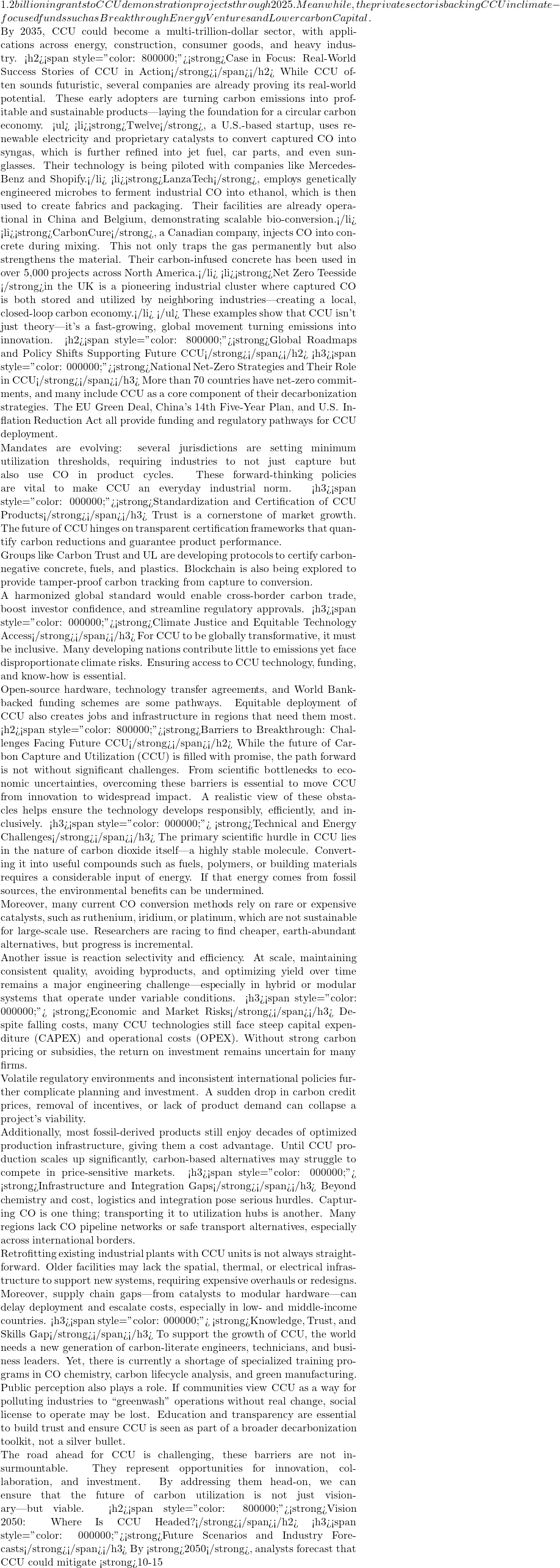 1.2 trillion, with key sectors including construction, aviation, chemicals, and consumer goods.
In high-ambition scenarios, CCU might also enable negative emissions when paired with Direct Air Capture, helping cool the planet while supporting economic growth.
CCU in the Space Economy and Extreme Environments
- NASA and ESA are researching closed-loop CO₂ recycling for Mars and Moon missions. Future off-Earth habitats will rely on systems that convert human-exhaled CO₂ into oxygen, water, and even food via algae or bacteria.
- CCU may also enable resource autonomy in harsh Earth environments like Antarctica, submarines, or disaster zones. These advances will likely spin off innovations for terrestrial use.
Public Perception, Education, and Workforce Shifts
The next generation of scientists and engineers will be carbon literate. Universities are already launching degrees in carbon management, green chemistry, and circular engineering.
Public awareness is crucial. As more products boast “made from CO₂” labels, consumers must understand their role in decarbonization. This cultural shift will reinforce CCU’s position as a cornerstone of climate action.

Future-Focused FAQs About Carbon Utilization
What will CCU look like in 10–20 years?
CCU will be widespread, decentralized, and integrated into daily life—from jet fuel and clothing to building materials and food packaging.
Can carbon utilization ever replace fossil fuels entirely?
It can replace many fossil-derived products but will work best alongside renewables, hydrogen, and electrification.
Will consumers prefer carbon-based products?
Yes, especially if priced competitively and verified as climate-positive.
Is future CCU safe and regulated globally?
With proper standards, CCU is both safe and environmentally beneficial. Global regulations are catching up.
Can CCU reverse climate change alone?
No. It’s one piece of a broader climate puzzle, including renewables, behavior change, and nature-based solutions.
Conclusion: From Carbon Crisis to Carbon Opportunity
Carbon dioxide has long been cast as the villain in the climate story—but the future of Carbon Capture and Utilization (CCU) is rewriting the script.
We now stand at the threshold of a carbon revolution—one where emissions are not just reduced or buried, but reimagined as building blocks for fuels, fabrics, packaging, and even life support systems in space. This isn’t science fiction—it’s science in action.
From AI-designed catalysts and modular CCU units to blockchain-certified carbon credits and floating ocean platforms, the innovations are real and accelerating. With smart investment, supportive policies, and public awareness, CO₂ can transform from a liability into a cornerstone of a circular, green economy.
But to get there, we need bold action:
🔬 Scientists must keep innovating.
🏛️ Policymakers must drive fair and global access.
💡 Educators must build a carbon-literate generation.
💰 Investors must scale what works.
CCU won’t solve climate change alone—but it’s a powerful piece of the puzzle. If we treat carbon not as waste, but as potential, we unlock a future where our greatest challenge becomes one of our greatest resources.
Carbon isn’t just the problem—it can be the solution.
Read More on Liquid Hydrogen Storage Technologies….
Resources:

